


There's a reason astronomers and astrophotographers have started quietly putting stargazing in Spiti Valley on their bucket lists. No light pollution for hundreds of kilometres. Altitude above 12,000 feet. Desert air that doesn't hold moisture or cloud cover. The Milky Way visible overhead with the naked eye.
Stargazing in Spiti Valley isn't a side activity for a lot of people who've been here, it ends up being the thing they remember most.
The best time to plan a trip to Spiti Valley for stargazing is June to October, peak being July–September. On a clear night you're looking at the Milky Way, meteor showers, distant galaxies, and more constellations than you knew existed. Places like Langza, Kibber, Chandratal Lake, Tabo, and Dhankar are where you want to be after dark.
This guide covers everything from top spots and best timing to tips for stargazing in Spiti Valley.
Why Is Spiti Valley Good for Stargazing?

Three things make Spiti exceptional for astronomy and stargazing:
- Altitude: Most of Spiti sits above 12,000 feet. Less atmosphere means less distortion and clearer stars.
- Zero light pollution: There are virtually no cities, industries, or large towns for hundreds of kilometres. The night sky is pitch black.
- Desert climate: Spiti is a cold desert. Rain is rare, humidity is low, and cloud cover is minimal, especially from late June to October.
Add to this the sheer remoteness and silence of the valley, and the night sky in Spiti Valley becomes something you genuinely can't replicate with a telescope set up elsewhere. This is the reason for increasing Astro tourism in Spiti Valley year by year.
Best-Selling Spiti Trips:

Spiti Valley Adventure Trip From Delhi: Kinnaur-Spiti Circuit

Spiti Valley Adventure From Chandigarh: Sangla, Kalpa & Tabo Special

Spiti Valley Road Trip: Chandratal & Pin Valley Circuit
Best Time For Stargazing In Spiti Valley

The best time for stargazing in Spiti Valley is from July to September. These are the times when the sky is most apparent, and you can see stars, planets, and other beautiful things in the night sky. Here's a quick breakdown of stargazing season in Spiti Valley, month by month:
- June: Roads have just opened, skies are largely clear. Nights are cold but manageable. Moderate tourist presence.
- July–August: Best overall — warm enough during the day, excellent sky clarity at night, and the Milky Way is at its brightest in the Spiti sky. Peak tourist season but the stargazing spots are never crowded after dark.
- September: One of the best months. Crowds thin out, skies stay clear, and the air becomes very crisp. Temperatures drop sharply after dark — can go below -5°C.
- October: October brings the clearest Spiti Valley weather for night sky viewing, almost zero cloud cover, though temperatures can hit -10°C or lower at altitude.
- Winter (November–May): Most roads and homestays are closed. Stargazing is phenomenal if you can handle -30°C, but not recommended for casual travellers.
7 Best Stargazing Spots In Spiti Valley
These seven Spiti Valley stargazing spots range from high-altitude villages to a glacial lake, each with a completely different sky experience.
1. Langza Village (4,400 m / 14,400 ft)

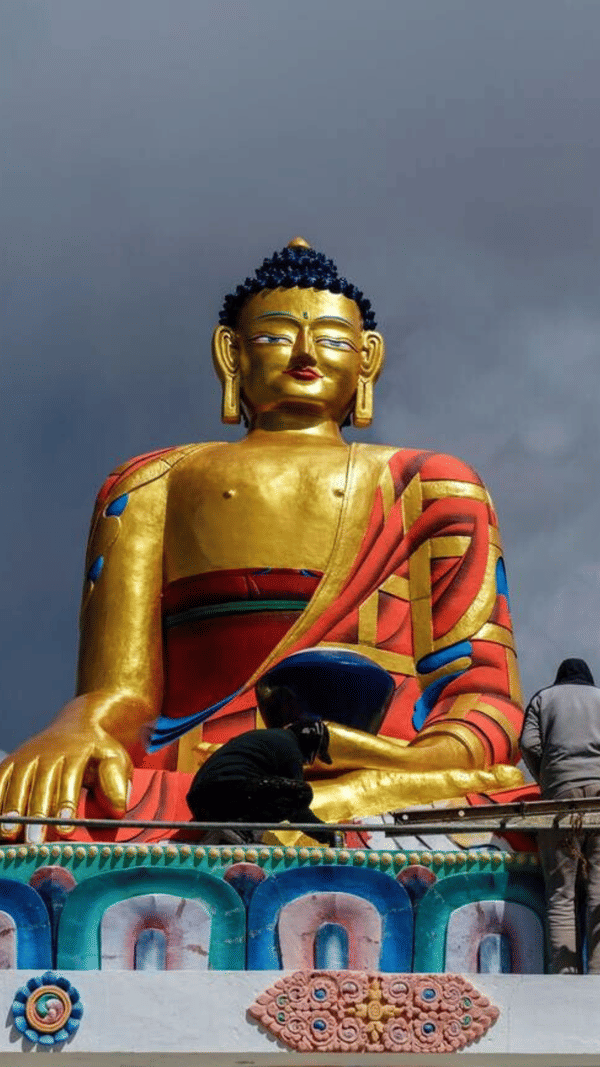
Langza sits in a wide, bowl-shaped valley above the Spiti River, surrounded by jagged fossil-rich ridges that drop away sharply on three sides. The village is tiny — a few dozen homes, a giant Buddha statue watching over crumbling ochre cliffs — and after 9 PM it's completely dark.
That combination of altitude, open terrain, and near-zero light pollution makes it the go-to stargazing village in Spiti. The Milky Way is visible overhead in a way that makes first-timers genuinely stop walking.
- Key spots: Buddha statue viewpoint, fossil trail beyond the village edge
- Highlight: Milky Way visible directly overhead July–September; galactic core clearly structured to the naked eye
- Best for: First-time stargazers, Milky Way photography, travellers wanting easy access from Kaza (~18 km)
- Pro tip: Walk 5–10 minutes outside the village towards the fossil hunting trail. You'll get a completely unobstructed, zero-light view of the Milky Way.
2. Kibber Village (4,270 m / 14,000 ft)

Kibber sits at the edge of a high plateau overlooking a canyon, with the Kibber Wildlife Sanctuary stretching out behind it — snow leopard territory, completely uninhabited for kilometres.
The village landscape is stark and open: no trees, no dense settlement, just low stone houses and a view that extends to distant snowfields. That barrenness is exactly what makes it exceptional at night — the horizon is unobstructed in nearly every direction, and the sky feels unusually wide.
- Key spots: Village rooftops, plateau edge above the canyon
- Highlight: Scorpius constellation fully visible; Milky Way arc from horizon to horizon
- Best for: Travellers who want dark skies with slightly more infrastructure than Komic or Hikkim
3. Chandratal Lake (4,300 m / 14,100 ft)

Chandratal, the Moon Lake, sits in a natural bowl ringed by rocky moraines and snowfields, fed by glacial melt, completely isolated from any settlement. Chandratal Lake stargazing is unlike anything else in Spiti. The still water doubles your sky, giving you stars both above and below, making it one of the best Spiti Valley stargazing spots.
On a still night, the stars and the Milky Way reflect almost perfectly in the lake surface, giving you the rare experience of feeling surrounded by sky from below and above simultaneously. There is no artificial light here for at least 30 km in any direction.
- Key spots: Lake edge (north shore gives the best sky reflection angle), open moraine above camp
- Highlight: Milky Way reflection in still water, one of the most photographed night skies in India
- Best for: Astrophotography, campers, travellers doing the Manali–Spiti road trip via Batal
4. Dhankar Monastery (3,894 m / 12,775 ft)

Dhankar Monastery is perched on a crumbling sandstone spire between two river valleys — Spiti and Pin — with a 360-degree panorama that's genuinely hard to believe during the day and stranger still at night. The monastery itself is ancient and partially in ruins, clinging to a rock that looks like it shouldn't support anything.
Almost no one stays overnight here; most visitors come for an hour and leave. That means the nights are among the quietest in Spiti — just wind, stars, and the sound of the river far below.
- Key spots: Monastery courtyard, trail up to Dhankar Lake (40 min walk, even darker)
- Highlight: Stars viewed from a cliff-edge ruin above two converging river valleys — dramatic and deeply quiet
- Best for: Travellers who want something off the standard circuit, those combining monastery visits with stargazing
5. Hikkim (4,440 m / 14,567 ft)

Hikkim Village is known for having the world's highest post office, but its real draw for stargazers is what it doesn't have: buildings, crowds, or light. It's a small cluster of homes on a high plateau, barely a dot on the map, tucked between Langza and Komic on the same ridge road.
The terrain here is almost perfectly flat and completely exposed for stargazing in Spiti Valley. You can see the sky all the way to the horizon on every side, something that even Langza can't quite offer due to surrounding ridgelines. Travelers looking for an easy Kaza stargazing experience, Hikkim and Langza villages are under 20 km from town.
- Key spots: Open plateau above the village, fields past the post office
- Highlight: Completely flat, treeless terrain — unobstructed full-circle horizon views rare even in Spiti
- Best for: Those doing the Langza–Hikkim–Komic loop who want to stop for a dedicated night session
6. Komic Village (4,587 m / 15,050 ft)

Komic Village sits on a high-altitude plateau so remote and elevated that it's one of the darkest permanently inhabited places in Asia. At 4,587 metres, you're above the atmospheric layer that causes stars to twinkle. From here, they burn steady and sharp, the way you'd see them through a telescope at lower altitudes.
The ancient Tangyud Gompa monastery stands at the edge of the village, and the surrounding plateau stretches out flat in every direction. Fewer than 100 people live here. After 8 PM, there is essentially no light source for as far as you can see.
- Key spots: Tangyud Gompa rooftop and surroundings, open plateau south of the village
- Highlight: One of the highest stargazing villages in Spiti; galactic dust lanes visible to the naked eye; Andromeda Galaxy identifiable without equipment
- Best for: Serious stargazers and astrophotographers who want the highest, darkest, least-visited sky in the valley
7. Tabo Village (3,050 m / 10,000 ft)

Tabo is the lowest spot on this list of stargazing in Spiti Valley but earns its place because of what surrounds it: a 1,000-year-old monastery built into a mud-walled complex, a narrow river valley hemmed in by towering eroded cliffs, and warm enough nights to sit outside comfortably without heavy gear.
The valley acts like a channel — your view of the sky runs in a long corridor along the valley axis, and the ancient monastery glowing faintly in starlight makes for a foreground that nothing else in Spiti can match.
- Key spots: Monastery rooftop (ask permission), open ground along the river
- Highlight: Stars framed by 1,000-year-old cave temples and cliff faces — unique in all of India
- Best for: Photographers wanting a cultural foreground, families, travellers sensitive to altitude
If you’re coming in from the north, the Spiti Valley from Manali route via Rohtang and Kunzum puts you closest to Chandratal first, before you drop into the main valley. If you’re entering from the south, the Spiti tour from Chandigarh route via Shimla and Nako brings you in through the lower valley and lets you climb gradually.
What Can You See In The Night Sky In Spiti Valley?

On a clear, moonless night in Spiti, here's what you'll spot without any equipment:
- The Milky Way: Fully visible as a thick luminous band across the sky, typically from July to September
- Andromeda Galaxy (M31): Faintly visible to the naked eye — about 2.5 million light years away
- Constellations: Scorpius, Orion (winter), Sagittarius (summer), Perseus, and Cassiopeia are all vivid
- Planets: Jupiter, Saturn, and Mars are easily spotted and visibly brighter than stars
- Shooting stars: On a typical night, you'll see 5–15 meteors per hour. During the Perseids (mid-August), this goes up dramatically
- Satellite trails: ISS and other satellites pass over regularly — you'll spot a few on any given night
- Star clusters: The Pleiades (Seven Sisters) and Hyades are strikingly clear
With binoculars or a small telescope, you can add:
- Jupiter's four Galilean moons
- Saturn's rings
- Dozens of star clusters in the Milky Way core
How To Plan A Stargazing Spiti Valley Tour?

If you're wondering how to plan a stargazing Spiti Valley tour, the simplest approach is to base yourself in Kaza for 4–5 nights and plan your spots around two loops:.
- Loop 1: High villages: Langza, Hikkim, Komic — one day trip by bike or cab from Kaza; stay overnight at Komic for the darkest sky
- Loop 2: Lower valley: Tabo and Dhankar together — best done while on Spiti Valley road trip via the Shimla route
- Chandratal: Needs a separate detour — plan it as an overnight on your way in or out via Manali
- Book homestays early: Komic and Hikkim have very few rooms — call at least a week ahead in July–August
Check the lunar calendar first and build your trip around a new moon window. Everything else follows from that.
Check Out Popular Spiti Valley Trips
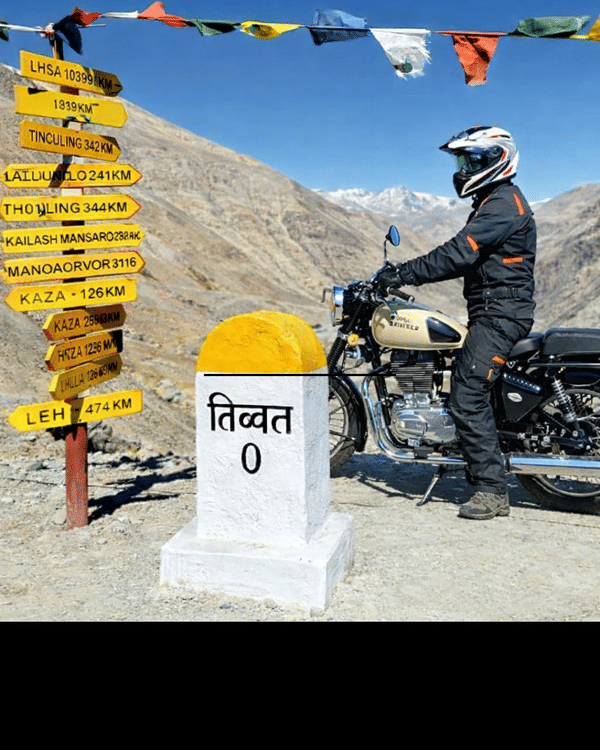
Thrilling Spiti Valley Bike Trip | Ride To The Edge At Lepcha La
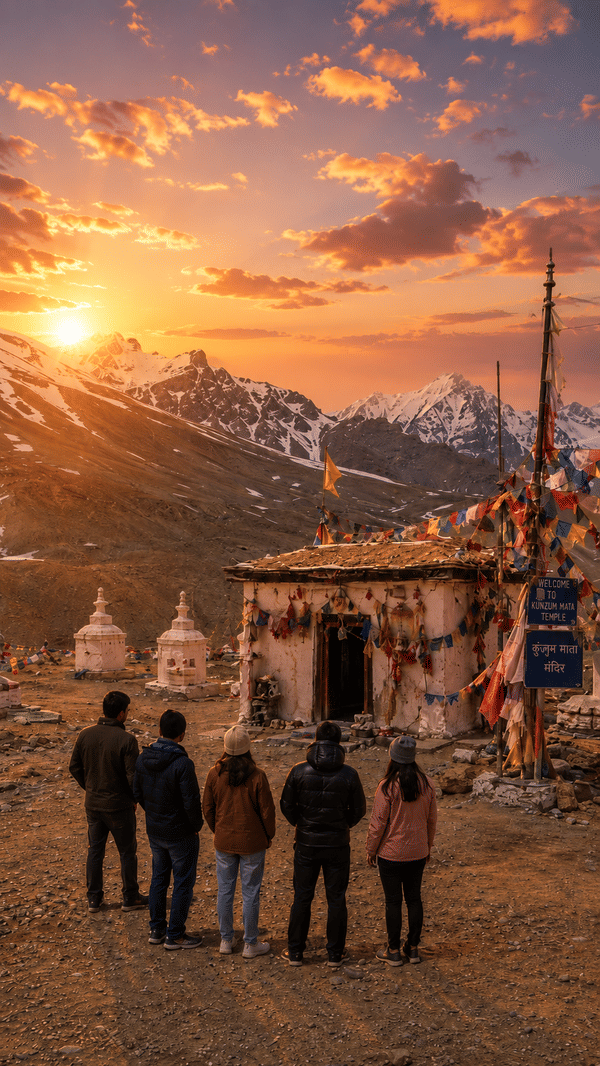
Spiti Valley Group Trip with Chandratal: Summer Edition
Spiti Valley Full Circuit Road Trip 7 Days | Value Saver Package from Delhi
Tips For Stargazing In Spiti Valley For Beginners

If this is your first time stargazing in Spiti Valley for beginners, three things matter most: moon phase, layering up, and dark adaptation.
Before you go:
Check the forecast before heading out — Spiti Valley weather for night sky is best checked on Windy or AccuWeather since local conditions shift quickly in October.
- Check the lunar calendar. Stargazing is best 5 days before and after a new moon. A full moon washes out the fainter stars and the Milky Way.
- Download a star map app like Stellarium or Sky Map, work offline and are excellent for identifying what you're seeing.
- Pack layers —temperatures at 4,000m+ can drop to -10°C or below even in August after midnight.
On the ground:
Follow these travel tips for Spiti Valleyfor stargazing to get the best views:
- Step away from any artificial light source for at least 10–15 minutes before looking up — your eyes need time to dark-adapt. Don't use your phone screen during this time.
- Use a red-light torch if you need to move around. Red light doesn't kill your night vision the way white light does.
- Lie flat on a sleeping mat or ground sheet. It's far more comfortable than craning your neck upward.
- Timing: The darkest and clearest hours are typically between 10 PM and 2 AM.
- Altitude affects your body. Don't do any strenuous walking just before a late-night session. Rest first, stargaze later.
For photography:
Spiti Valley is safe for night photography as long as you're prepared for the cold and altitude. Here are some tips to follow:
- Use a wide-angle lens (14–24mm) if shooting the Milky Way
- ISO 1600–3200, aperture f/2.8 or wider, shutter speed 15–25 seconds
- Bring a sturdy tripod — wind at altitude will ruin long exposures
- The Buddha statue at Langza and the monastery at Dhankar are the best foreground subjects for Milky Way shots.
Plan Your Trip For Stargazing In Spiti Valley?
If you've ever wanted to see the Milky Way with your naked eye — not in a photo, but actually above your head, Spiti Valley is one of the few places in India where it reliably happens. The combination of extreme altitude, desert air, and genuine remoteness creates conditions that most stargazers only dream about.
You don't need to be an astronomy enthusiast to be moved by a Spiti night sky. You just need to be there, away from any light, and look up. That's usually enough. Bookmark this Spiti Valley travel guide and come back to it when you're planning dates.
WanderOn's Spiti Valley tour packages are designed around the best stargazing windows — everything planned, nothing left to chance. Book your spot today!
Frequently Asked Questions
Is Spiti Valley Safe for Night Photography?
Yes — the villages are extremely safe at night. The only real risks are altitude-related fatigue and the cold. Stick to known spots around the village, go with someone if you're shooting past midnight, and tell your homestay host where you're heading.
Where is the best place for stargazing in Spiti Valley?
Langza and Komic are the top picks — both sit above 14,000 ft with open terrain and virtually no light. Komic edges ahead on darkness and elevation. Chandratal Lake is the one to beat for photography.
Do I need special equipment for stargazing in Spiti?
No. The naked eye is enough — the Milky Way, Andromeda Galaxy, and dozens of constellations are all visible without a telescope. Binoculars help but aren't essential. A red torch and warm layers matter more than any optical gear.
What is the best time for stargazing in Spiti Valley?
July to September. Skies are clearest, roads are open, and the Milky Way is at peak visibility. Plan around a new moon window — that single factor matters more than which month you pick.
When is the best time for stargazing in Spiti Valley?
Late July through September is the sweet spot — warm enough during the day, dry and clear at night. October works too if you can handle sub-zero temperatures after dark. Avoid full moon nights regardless of when you go.
Are any guided stargazing tours or experiences available in Spiti Valley?
Formal guided astronomy tours are limited in Spiti, but some homestay hosts in Langza and Komic are familiar with the sky and happy to help you orient. WanderOn's Spiti packages can be planned around peak stargazing windows specifically.
What are some recommended stargazing spots in Spiti Valley?
Langza, Komic, Hikkim, Kibber, Chandratal Lake, Tabo, and Dhankar Monastery. Each offers something different — Komic for pure darkness, Chandratal for reflection photography, Tabo for a 1,000-year-old monastery as foreground. Pick based on how high and remote you want to go.
Where can I see the Milky Way in Spiti Valley?
You can see the Milky Way anywhere above 14,000 ft in Spiti on a moonless July or August night, honestly. Langza and Komic are the most reliable — flat terrain, no ridgelines blocking the view, and dark enough that the galactic core is visible to the naked eye.
What makes Spiti Valley an excellent destination for stargazing?
Three things: altitude above 12,000 ft, a cold desert climate with minimal cloud cover, and zero light pollution for hundreds of kilometres in every direction. Very few places in India — or Asia — combine all three naturally.


