


If you're figuring out the Manali to Spiti Valley route, here's the first thing to know before your trip: it's shorter, rawer, and far more dramatic than the Shimla-Spiti route.
Manali to Spiti distance is about 200 km and it takes 10 to 12 hours because you're crossing Kunzum Pass at 14,931 feet, navigating live river crossings, and riding through tough stretches like Gramphu and Batal. However, the route is only open from mid-May to mid-October as the snow shuts it down entirely after that.
Riders and road trippers who are reasonably fit and okay with uncertainty almost always choose this route for their trip to Spiti Valley for a raw and deeply rewarding experience.
AMS is real due to sharp ascent and can affect anyone without proper acclimatization. Anyone with a heart condition or respiratory issues should consult their doctor before booking, or consider the Shimla route instead.
This guide covers everything including full Manali to Spiti Valley group trips route breakdown, altitude checkpoints, Spiti Valley road conditions, and what to sort before you leave Manali.
Popular Spiti Valley Trips Via Manali:
Spiti Valley Group Trip with Chandratal: Summer Edition

Spiti Valley Tour From Manali: Chandratal Camping & Kibber Wildlife

Chandigarh To Spiti Valley Road Trip | Complete Himalayan Expedition
How To Reach Spiti Valley From Manali?

There is no airport or railway station in Spiti. Every route into the valley ends with a road journey, no matter how you start. Here's how to go from Manali to Spiti Valley depending on your mode of travel.
By Road (Most Common)
The direct drive from Manali to Kaza is 185-200 km (as shown on Google maps) via the Atal Tunnel, Gramphu, Batal, and Kunzum Pass.
What is the road condition from Manali to Spiti Valley?
Spiti Valley road conditions vary significantly by month and stretch; expect the roughest patches between Gramphu and Batal, which often involve navigating glacial melt and "nullahs."
- Manali to Spiti Distance: About 185-200 km
- Duration: 8 to 10 hours (weather depending)
- Route open: Mid-June to mid-October only (subject to snow clearance at Kunzum Pass)
There are three ways for your Spiti Valley road trip:
Option A: By Private Vehicle / SUV
Best for comfort and safety, especially if traveling with family or friends. High-clearance vehicles are non-negotiable.
- Best vehicle: 4x4 or SUV (Innova, Scorpio, Fortuner)
- Manali to Spiti Valley taxi fare:₹10,000 to ₹15,000 for a drop
- Hiring point: Manali taxi stand or pre-booked through local Spiti-based operators
Option B: By Bike
The most popular way for adventurers. On a Manali to Spiti Valley bike trip, every river crossing hits differently on two wheels.
- Best bikes: Most of the Spiti bike trips use Royal Enfield Himalayan, KTM Adventure, or similar high-clearance adventure bikes.
- Duration: 8 to 10 hours; many bikers stop overnight at Batal or Chandratal
- Fuel: Last reliable fuel is at Manali or Tandi (taking a 15 km detour). Carry extra cans.
Option C: By Bus (HRTC)
Going from Manali to Spiti Valley by bus is the most budget-friendly way. Two daily HRTC buses operate once the Kunzum Pass is officially opened by the BRO.
- Departure:~5:00 AM from Manali Main Bus Stand
- Duration: 10 to 12 hours
- Cost: Under ₹600
- Note: Seats fill fast; arrive at the station early to get a seat on the Manali to Spiti Valley bus or check the HRTC website. You can get back on the Spiti to Manali bus similarly.
By Air + Road
There are no direct flights from Manali to Spiti Valley. You need to fly into the nearest airport and continue by road.
- Nearest airport: Kullu-Manali Airport, Bhuntar — 50 km from Manali
- Connected from: Delhi, Chandigarh, and Amritsar (check for seasonal availability)
- Better option: Fly into Chandigarh (well-connected, year-round) and drive or take a bus to Manali taking roughly 6 to 8 hours via the new Kiratpur-Manali highway
- Manali to Kaza by road after landing: Add another 8 to 10 hours
By Train + Road
There is no Manali to Spiti Valley by train option. No railway line reaches Manali. Take a train to the nearest railhead and continue by road.
- Nearest railhead: Chandigarh or Ambala — both well-connected from Delhi to Manali and other major cities
- Chandigarh to Manali: 6 to 8 hours by road via the new highway
- Joginder Nagar station: Technically closer, but it is a narrow-gauge line with very slow connectivity and is not recommended for this route.
- Total travel time:~18 to 22 hours, typically split over two days with a night stay in Manali.
Manali To Spiti Valley By Road: What Kind Of Trip Is This?

The Manali to Spiti route is a high-altitude transit through a transition zone where the road often disappears. The Manali to Spiti Valley route spans 200 km, climbing from 6,700 ft in Manali to 12,500 ft in Kaza, with the Kunzum Pass summit reaching 14,931 ft.
The Gramphu–Batal section is the most underestimated part of the trip. Most drivers plan their day based on digital map estimates, which fail to account for the 60 km "riverbed" stretch that can take upwards of four hours.
The Manali To Spiti Route At A Glance:

- Manali to Atal Tunnel [28 km / ~1 hour]: Excellent paved highway, the easiest stretch of the entire route.
- Gramphu to Batal [62 km / 3 to 4 hours]: The toughest section. Rocky terrain, live water crossings, and no real road for long stretches. This is where most people underestimate the journey.
- Batal to Kunzum Pass [14 km / ~45 minutes]: Short but steep. High-altitude climb with rough surface; take it slow here.
- Kunzum Pass to Kaza [76 km / ~2 hours]: Mostly paved with some dirt patches. Roads ease up considerably once you cross the pass and drop into Spiti.
What this route demands from a self-driver:
- Confidence in off-road driving: handling boulders, loose gravel, and glacial nallahs
- An early start, departing Manali no later than 6:30 AM
- A high-clearance vehicle (SUV/4x4)
- Hard cash carried from Manali; UPI is non-functional in the transit zone
- Check the latest Spiti Valley weather conditions before visiting.
- Offline maps (GPS signal drops after the Atal Tunnel)
Also read: Shimla To Spiti Valley Bike Trip: The 2026 Rider’s Guide
Manali To Spiti Valley Route Via Kunzum Pass

Route: Manali → Atal Tunnel → Gramphu → Chhatru → Batal → Kunzum Pass → Losar → Kaza (Spiti)
Segment 1: Manali to Atal Tunnel North Portal (~35 km)
The road through Solang Valley to the Atal Tunnel is smooth tarmac. The 9.02 km tunnel bypasses the traditional Rohtang Pass, cutting the journey to the Lahaul Valley by nearly 46 km and 2+ hours.
Logistics Note: Rohtang Pass is now largely irrelevant for Spiti-bound travellers. While Indian nationals do not need a permit for the Atal Tunnel, those specifically wanting to visit Rohtang must secure a separate permit (₹400–₹800).
Expert Tip: Before heading toward Gramphu, ensure your tank is full. If you missed the Manali pumps, take a 15-minute detour toward Keylong to the Tandi Petrol Pump. This is the last reliable fuel station before the 200 km Spiti stretch begins.
Segment 2: Gramphu to Batal (~60 km)
At the Gramphu junction, the road forks right toward Spiti, and the tarmac ends almost immediately. This 60 km stretch is a rocky track alongside the Chandra River, featuring multiple pagal nallahs (glacial streams).
Critical timing rule: Water levels in these streams rise sharply after 1:00 PM as the sun melts higher glaciers. WanderOn trip captains advise clearing Gramphu before noon. Groups departing Manali after 8:00 AM frequently face risky, knee-deep water crossings by the time they reach Chhatru.
Segment 3: Batal: The Mandatory Stop
Batal (13,123 ft) is a critical rest point. The Chacha-Chachi Dhaba is a Himalayan institution where travellers stop for hot meals and vehicle checks. Batal is also the junction for the detour to Chandratal Lake (14 km away).
Segment 4: Batal to Kunzum Pass (~14 km)
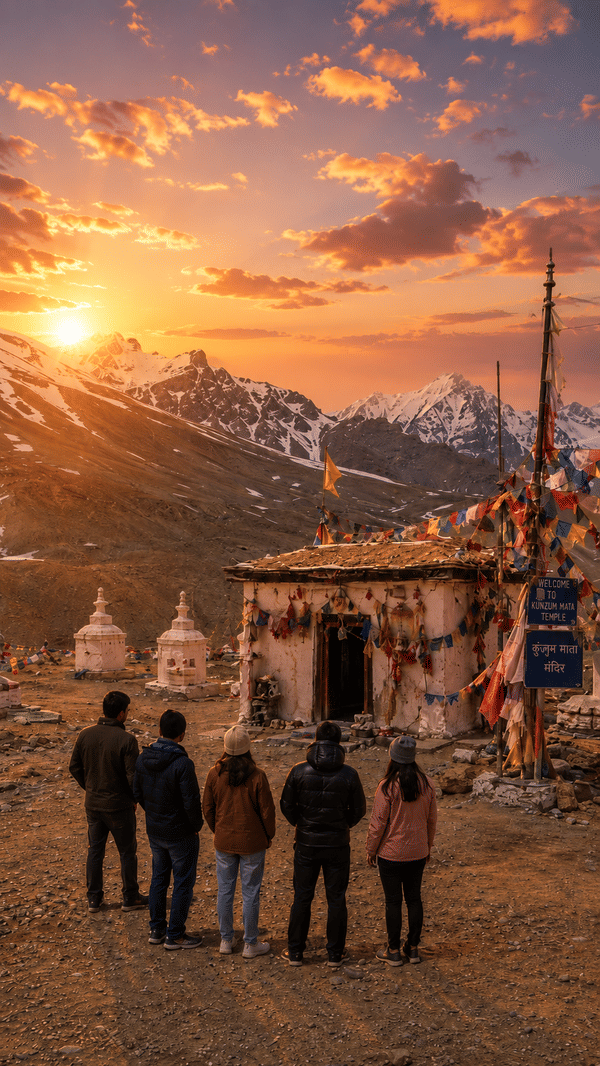
This is a steep, switchback-heavy climb to 14,931 ft. The road is rough, but the distance is short. It is customary to circle the Kunzum Mata temple at the summit.
Seasonal Note: Kunzum Pass typically opens in early June and closes by mid-October. WanderOn's Spiti group departures always verify the pass status 48 hours prior, as early snowfall can shut the route unexpectedly.
Segment 5: Kunzum Pass to Losar to Kaza (~76 km)
The descent into Losar village leads to the first proper police checkpost where vehicle details are recorded. The road quality improves significantly from here into Kaza, passing through the classic cold-desert landscape of the Spiti River canyon.
Please Note: The Losar Police Checkpost is the mandatory stop for all travelers. Indians have to show their ID and Foreign nationals must present their Protected Area Permit (PAP) to enter the valley. Read on detailed Spiti permit informationfor Indians and foreigners before traveling.
Best Vehicle For The Manali–Spiti Self-Drive

Ground clearance is the single most important factor for this journey. The stretch between Gramphu and Batal is essentially a riverbed of boulders and glacial melt that will test both machine and metal.
Recommended 4-Wheelers (High Clearance)
- Mahindra Thar / Scorpio N: Excellent approach angles for deep water crossings (nullahs).
- Toyota Fortuner: The most reliable power delivery for high-altitude climbs.
- Bolero / Bolero Neo: The local favorite for its rugged suspension and easy repairability.
Expert Note: A fully loaded Innova Crysta (178mm clearance) often bottoms out between Chhatru and Batal. If driving one, passengers should deboard at deep crossings to avoid undercarriage damage. Sedans and hatchbacks are not recommended.
Recommended Bikes (Adventure & Dual-Sport)
- Royal Enfield Himalayan (450/411): Specifically built for this terrain; the 21-inch front wheel handles boulders with ease.
- KTM Adventure 390 / 250: Great power-to-weight ratio for steep climbs, though the stiff suspension can be felt on gravel.
- Hero Xpulse 200 4V: The lightweight champion; easiest to maneuver through mud and deep slush.
RE Interceptor 650: Capable due to high torque, but requires a sump guard and an experienced rider due to its weight and lower clearance.
Explore Popular Spiti Valley Bike Trips:

Thrilling Spiti Bike Trip From Manali Via Pin Valley & Chandratal

Ultimate Spiti Bike Expedition From Chandigarh

Spiti Circuit Biking Expedition From Delhi: Chandratal Special
Pre-departure Checklist:
- The Machine: Full-sized spare tyre (car) or spare cables (bike: clutch/accelerator), puncture kit, and a portable air inflator.
- Fluids: 1L engine oil, 2L pre-mixed coolant, and a 5L backup fuel can (essential for bikes).
- Recovery Gear: Heavy-duty tow rope, jump-start cables, and a basic toolkit (jack, lug wrench).
- Navigation: Offline Google Maps for the "Manali-Kaza" region.
- Consider going through the full Spiti Valley travel checklist too to plan a smooth and safe trip.
Best Time For The Manali To Spiti Self-Drive

The best time for Manali to Spiti Valley drive is September to early October. During this window, the monsoon has receded, the water levels in the nallahs are at their lowest (usually ankle-deep), and the sky remains clear.
- June – July: High adventure, but water crossings are at their deepest.
- August: High risk of landslides on the approach roads to Manali due to rain.
- Mid-October onwards: High risk of getting stranded due to early snow at Kunzum Pass.
For a season-by-season breakdown, check out the best time to visit Spiti Valley and plan accordingly.
Places To Visit During Manali To Spiti Valley Road Trip
1. Chandratal Lake

Chandratal Lake is one of the most beautiful Spitian wonders located at an altitude of 14,100 feet above sea level. It is famous for its crystal-blue waters, stunning reflections and a great camping experience near the lake. One of the most rewarding detours on the Manali to Spiti route, accessible from Batal. It’s generally open from mid-June to early October.
- Altitude: 14,100 feet
- Distance from Manali: 140 Kilometers
2. Kunzum Pass

Kunzum Pass is a high mountain pass in Himachal Pradesh and one of the best places to visit in Spiti Valley for travelers. It connects the beautiful Lahaul Valley with the Spiti Valley and is located at an altitude of about 4,590 meters. It’s a favorite spot for adventure lovers and road trip enthusiasts.
- Altitude: 14,931 feet
- Distance from Manali: 122 Kilometers
3. Pin Valley National Park

Pin Valley National Parkis a magical place hidden in the cold mountains of Himachal Pradesh. It lies in the Spiti Valley and is full of rocky hills, snowy peaks, and clear blue skies. This park is special because it is home to rare animals like the snow leopard and the Himalayan ibex. You can also spot colorful birds flying high in the sky.
- Altitude: 3,500 - 6,632 meters
- Distance from Kaza: 32 Kilometers
4. Dhankar Monastery

Dhankar Monastery is one of the best places to visit during the Manali to Spiti Valley trip that offers breathtaking views of the Spiti river. Monks live here and spend their days in prayer and meditation, adding to the calm and spiritual vibe. Dhankar Lake is also a quiet and beautiful spot, located high up in the mountains and can be reached by a short trek from the monastery.
- Altitude: 12,774 feet
- Distance from Kaza: 32 Kilometers
5. Kibber Village

Kibber Village is a small and beautiful village in the Spiti Valley of Himachal Pradesh. It is one of the highest villages in the world that is connected by a road. The village is surrounded by tall mountains and wide open lands, making it look like a picture from a postcard.
- Altitude: 14,010 feet
- Distance from Kaza: 20 Kilometers
6. Key Monastery

Key Monastery is a beautiful and important monastery in Spiti Valley, Himachal Pradesh. It is located on a hilltop and offers stunning views of the valley below. The monastery is over 1,000 years old and is one of the largest in the region. It is home to many monks who practice Buddhism and teach its teachings.
- Altitude: 14,000 feet (approx.)
- Distance from Kaza: 14.3 Kilometers
7. Tabo Monastery

Tabo Monastery is one of the must visit places during Manali to Spiti Valley trip. It is the place where you get to understand Buddhist heritage and culture. This ancient monastery, also known as the “Ajanta of the Himalayas”, is also celebrated for the exquisite murals.
- Altitude: 10,010 feet
- Distance from Kaza: 48 Kilometers
Best Manali To Spiti Itinerary For 7 Days

DAY 0: Delhi to Manali
- Start your journey from Delhi to Spiti Valley by evening and reach Manali next morning.
DAY 1: Reach Manali (Overnight stay at Manali)
- As you arrive in Manali by morning, check-in to the hotel and relax.
- After breakfast, explore the local area including Mall Road, Hidimba Temple, and Old Manali.
- Spend the day relaxing to let your body adjust to the mountain air.
- Come back to the hotel by evening for a trip briefing and overnight stay.
DAY 2: Manali to Kaza (Via Atal Tunnel)
- Start your journey early in the morning toward Kaza to cross the water nullahs before the midday glacial melt.
- Pass through the Atal Tunnel and the rugged terrain of Gramphu and Batal.
- Cross the high-altitude Kunzum La pass, the gateway to Spiti Valley.
- Reach Kaza by evening and rest to adapt to the 12,500 ft elevation.
DAY 3: Kaza to Mudh (Pin Valley)
- Drive toward the stunning Pin Valley, known for its unique green landscapes and wildlife like the Snow Leopard.
- Visit the Kungri Monastery and enjoy the serenity of Mudh Village, the last motorable village in the valley.
- Spend the evening walking around the village and soaking in the "Old Spiti" vibe.
- Overnight stay in Mudh (Pin Valley).
DAY 4: Mudh to Dhankar and Tabo
- Head toward Dhankar, the former capital of Spiti, and visit the Dhankar Monastery perched precariously on a cliff.
- If energy permits, do the short trek to Dhankar Lake for a panoramic view of the confluence of Spiti and Pin rivers.
- Continue to Tabo to visit the "Ajanta of the Himalayas", a 1000-year-old UNESCO World Heritage monastery.
- Overnight stay in Tabo or Dhankar.
DAY 5: Tabo to Kaza (The High-Altitude Loop)
- Head back toward Kaza and visit the iconic Key Monastery.
- Explore the highest inhabited regions: Hikkim (World’s Highest Post Office), Komic (World’s Highest Village), and Langza (The Fossil Village).
- Cross the Chicham Bridge, the highest suspension bridge in Asia, before returning to Kaza.
- Overnight stay in Kaza.
DAY 6: Kaza to Chandratal Lake
- Commence your journey toward the mesmerizing Chandratal Lake (14,100 ft).
- Check into your campsite near the lake and spend the afternoon trekking the final stretch to the water.
- Witness the lake's crystal-clear reflection as the sun moves across the sky.
- Overnight stay in high-altitude camps near Chandratal.
DAY 7: Chandratal to Manali & Departure
- Start your final drive early in the morning to navigate the rough Batal-Gramphu stretch.
- Reach Manali by late afternoon, allowing time for a final meal in Old Manali.
- Start your overnight journey to Delhi and reach by next morning.
Top-Selling Spiti Valley Tour Packages

Spiti Valley Group Adventure | Exclusive Himalayan Escape
Spiti Valley Full Circuit Road Trip 7 Days | Value Saver Package from Delhi

Frozen Spiti Backpacking - Bliss in Budget
Travel Tips For Manali To Spiti Valley Route

Consider these essential travel tips for Spiti Valley before planning your trip:
- Start before 6 AM. River crossings are shallower in the morning before glacial melt picks up through the day. Afternoon crossings at Batal and Gramphu are significantly harder.
- Last fuel stop is Manali. The next reliable petrol pump is in Kaza, 202 km away. Carry a jerry can.
- Don't trust Google Maps time estimates. It will show 6 hours. It will take 10 to 12. Plan accordingly.
- Carry cash. No ATMs between Manali and Kaza. Gramphu, Batal, and Losar have nothing.
- Acclimatise before you push through. Don't drive straight from Manali to Kaza in one shot if you've just come from the plains. A night at Chandratal or Losar helps significantly.
- Keep an eye on the sky after noon. Weather shifts fast above Kunzum Pass. If clouds are building, don't wait it out on the road.
- A high-clearance vehicle is non-negotiable for the Gramphu to Batal stretch. Sedans and hatchbacks regularly get stuck here.
Prepare For Your the Manali to Spiti Valley Adventure
The Manali to Spiti Valley route is a high-altitude adventure for bikers and road trippers. Is Manali to Spiti route safe? Yes, if you respect the conditions. A high-clearance vehicle, an early start, and awareness of nullah timings are what separate a smooth crossing from a stuck one.
While the river crossings and rugged passes demand respect, the raw beauty of the trans-Himalayas is an unmatched reward.
Don't leave your adventure to chance; let the experts handle the logistics, oxygen, and backup. Plan your ultimate Spiti road escape with WanderOn today!
Frequently Asked Questions
How far is Manali to Spiti Valley?
The total distance from Manali to Spiti Valley (Kaza) is approximately 185 km to 202 km. While the mileage seems low, the rugged terrain and high-altitude passes mean the journey typically takes 10 to 12 hours of active driving.
What is the route from Manali to Spiti Valley?
The most popular route from Manali to Spiti Valley goes through the Atal Tunnel, Gramphu, Chhatru, Batal, and the 14,931 ft Kunzum Pass. This transit takes you from the lush greenery of Kullu into the stark, high-altitude cold desert of Spiti.
How many days are required for Manali to Spiti trip?
At least 6 to 7 days are required for Manali to Spiti trip to ensure proper acclimatization and safe travel. A week-long journey allows you to explore Pin Valley, Tabo, and Chandratal without rushing through the dangerous, high-altitude terrain.
Is Manali to Spiti route safe?
The Manali to Spiti route safety depends entirely on weather and vehicle choice. While the road is manageable for experienced drivers in high-clearance SUVs, unpredictable landslides, deep glacial nallahs, and extreme altitudes require constant caution and a very early morning start.
What is the best time to travel from Manali to Spiti?
The best time to travel from Manali to Spiti is from June to September. During this window, the Kunzum Pass is open, and the roads are clear of heavy snow, though September offers the most stable weather and shallower water crossings.


