Freedom Square Tbilisi has a gilded St. George at its centre, spearing a dragon from the top of a 35-metre column. Zurab Tsereteli's statue replaced Lenin here in 2006, eleven years after the old monument came down. City Hall's arcades face the square from the south, Rustaveli Avenue runs west from the far corner, and the old town starts a five-minute walk east.
Liberty Square, Tbilisi, as it is also known, has carried several names across its history, each one reflecting the government that used it. It has been a parade ground, a site of mass protest, and the location of one of the most significant political moments in modern Georgian history. Today, it serves as the functional centre of a capital that has changed faster in the last twenty years than in the century before.
We include Freedom Square on almost every Tbilisi city tour we run, not as a stop in itself but as the natural starting point for a day that moves from Rustaveli Avenue through the old town and down to the sulfur bath district of Abanotubani. If you are planning a trip, our Georgia tour packages cover Tbilisi properly, with enough days in the city to go beyond the square and understand what surrounds it.
Freedom Square Tbilisi at a Glance
History of Freedom Square Tbilisi
Freedom Square has been the civic centre of Tbilisi since the nineteenth century, when the city was under Russian imperial administration and the space was developed as a formal public square. Over the years, it has carried different names reflecting Georgia’s changing political history:
- Erivan Square during the Russian imperial period
- Lenin Square during the Soviet era
- Freedom Square after Georgia moved towards independence
During the Soviet period, a large statue of Lenin stood at the centre of the square. It was removed in 1991, as the Soviet Union collapsed and Georgia declared independence.
The St. George Monument
The square took on its current appearance in 2004, following Georgia’s Rose Revolution of 2003. A 22-metre column topped by a statue of St. George slaying the dragon was erected at its centre.
The monument became a symbol of post-revolution Georgia and represented the country's political shift under Mikheil Saakashvili, who was empowered following the Rose Revolution.
The April 9, 1989 Tragedy
Freedom Square also carries the memory of one of the most significant events in Georgia’s modern history.
On April 9, 1989, Soviet troops dispersed a peaceful pro-independence demonstration in the square, killing 20 people. The event became a defining moment in Georgia’s independence movement, and the country now observes April 9 as a national day of remembrance.
What Is Freedom Square Famous For?
The history of Liberty Square in Tbilisi reflects much of Georgia’s turbulent twentieth century, from Russian imperial administration and Soviet rule to independence and the reforms that followed the Rose Revolution.
Today, the square is both a busy transport hub and one of Tbilisi’s most recognisable landmarks, with its changing names, monuments and historic events offering a snapshot of the country’s political and cultural journey.
How to Reach Freedom Square Tbilisi
It is important to choose the right method of travel when discovering Freedom Square Tbilisi attractions. Here are the best ways:
- By Metro: The Freedom Square metro station is directly beneath the square and is the easiest way to reach it from any part of the city. The Tbilisi Metro runs two lines, and the Freedom Square station is on the Akhmeteli-Varketili line. A single journey costs one lari, and the metro operates from approximately six in the morning until midnight.
- On Foot from the Old Town: From the Abanotubani district and the old town, Freedom Square is about a fifteen- to twenty-minute walk heading north through the old town streets. The walk passes through some of the most interesting parts of the city.
- By Taxi or Bolt: From Tbilisi Airport, a taxi or Bolt ride to Freedom Square takes twenty to forty minutes depending on traffic and costs between fifteen and twenty-five lari by app. Bolt is the most reliable option for consistent pricing.
With our Georgia packages, Freedom Square is the starting point for the Tbilisi city tour on most group departures. The trip captain meets the group at or near the square, and the day moves outward from there through Rustaveli, the old town, Narikala, and Abanotubani.
Where Is Freedom Square Located?
Freedom Square Tbilisi sits at the head of Rustaveli Avenue, where the nineteenth-century Russian-built city meets the medieval core running down towards the Mtkvari River and Narikala ridge.
Location: Tbilisi, Georgia
The Freedom Square Tbilisi location puts most of the city's sights within walking distance:
- Rustaveli Avenue: Theatres, museums and Soviet-era architecture, starting at the square's western edge
- Georgian National Museum: 5 minutes along the avenue
- Old town: 15 minutes southeast, for the wooden balcony houses and Metekhi Church
- Narikala Fortress: 30 minutes on foot, or a short cable car ride from the old town
Tbilisi City Hall and several government buildings face the square, which gives it a formal, institutional feel rather than an atmospheric one. Most people pass through rather than linger, and that's the right call. The square is the map, not the destination.
Best Time to Visit Freedom Square Tbilisi
Freedom Square itself is accessible year-round and at any hour, since it is an open public square rather than a ticketed attraction. The best time to visit in terms of city weather is spring, from April to June, and autumn, from September to November, when the temperatures in Tbilisi are mild and the light in the old town in the late afternoon is at its best. These months are also usually considered the best time to visit Georgia.
- Summer in Tbilisi, particularly July and August, is hot, reaching thirty-five degrees on the warmest days, and the square itself offers no shade. If you are visiting in summer, the early morning and evening are the best times to be on Rustaveli Avenue and in the old town. The sulfur baths are particularly worth doing in the heat of summer, since they are underground and cool. Most Georgia tour packages in summer build the outdoor walking into these cooler hours for exactly this reason.
- Winter in Tbilisi: Cold but manageable, and the city stays busy through December because of Christmas and New Year departures from India. The square and the surrounding streets are at their quietest in January and February, which suits anyone who wants the old town without the tourist crowd.
Places to Visit Near Freedom Square Tbilisi
- Rustaveli Avenue: The main boulevard of the city, beginning at the square and running west through the cultural and institutional heart of nineteenth and twentieth-century Tbilisi. The architecture along the avenue is worth seeing, even if you don't enter any buildings.
- Georgian National Museum: On Rustaveli Avenue, ten minutes from the square. The permanent collection covers Georgian history from the Bronze Age to the Soviet period, and the treasury downstairs is exceptional.
- Metekhi Church: On a cliff above the Mtkvari River, visible from the Freedom Square area on a clear day and about twenty minutes on foot through the old town. The church dates to the thirteenth century, and the cliff setting is the reason to go as much as the building itself.
- Narikala Fortress: The fourth-century fortress on the ridge above the old town, reached by cable car from the Abanotubani district or by foot on a path that climbs through the fortress walls. The views from the top cover the full sweep of the old city.
- Abanotubani Sulfur Bath District: Below Narikala, the oldest continuously operating part of the city. The domed bathhouses, the Legvtakhevi waterfall, and the winding lanes of the district make it the most atmospheric quarter in Tbilisi.
- Sioni Cathedral: In the old town, about fifteen minutes on foot from Freedom Square. The cathedral dates to the sixth century in its original form and holds the cross of St. Nino, the figure credited with bringing Christianity to Georgia. It is smaller and quieter than Sameba, which makes it easier to spend time in.
Things to Do Around Freedom Square Tbilisi
The square itself is a transit point. The things to do around Freedom Square Tbilisi are in every direction from it, and a well-planned day can cover most of what the city does best by starting here and moving outward.
1. Walk the full length of Rustaveli Avenue: Rustaveli Avenue runs from Freedom Square westward for about one and a half kilometres to Rose Revolution Square, passing the Georgian National Museum, the Rustaveli Theatre, the Parliament building, and the 19th-century facades that make this the most formally European street in the city. It is the right walk for a first morning in Tbilisi, done slowly with stops, before the old town pulls you in the other direction.
2. Visit the Georgian National Museum: A ten-minute walk from Freedom Square along Rustaveli, the Georgian National Museum holds the most comprehensive collection of Georgian archaeology, medieval art, and twentieth-century history in the country. The treasury in the basement, with its gold jewellery from the ancient Colchis culture, is the reason to spend more than an hour in the museum.
3. Walk down into the old town: From the eastern side of Freedom Square, the streets drop away toward the Mtkvari River and the old town district of Kala. This is where the wooden balcony houses are, where the small courtyard restaurants sit behind unmarked doors, and where the city feels the oldest. The walk from Freedom Square to the river takes about fifteen minutes and passes through the most atmospheric streets in Tbilisi.
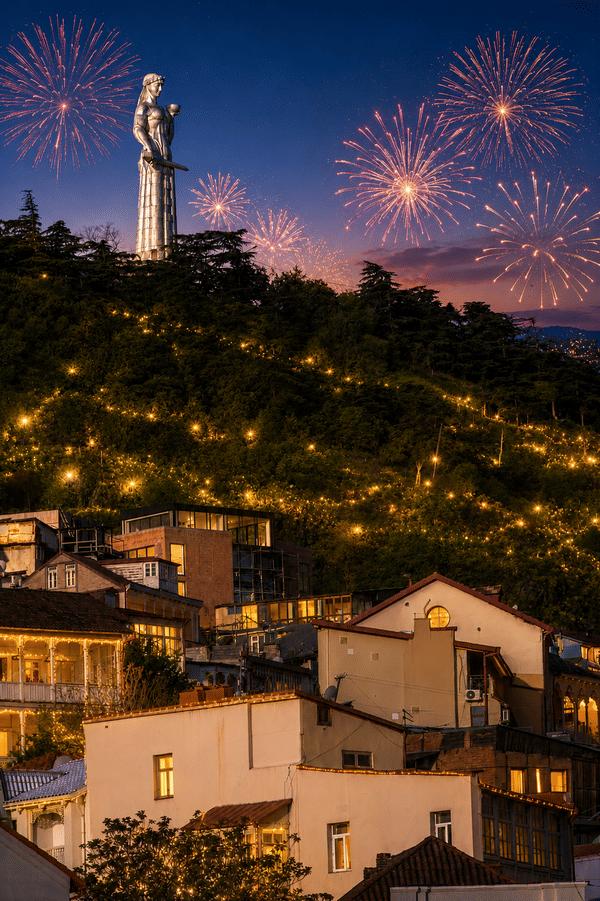
4. Take the cable car up to Narikala Fortress: From the old town below, a cable car runs up to the Narikala Fortress ridge and the Mother of Georgia statue above it. The fortress itself dates to the fourth century and the views from the ridge cover the old town, the river, and the Metekhi Church on the opposite bank. It is one of the best things to do in Tbilisi and is about thirty minutes on foot and by cable car from Freedom Square.
5. Cross the Bridge of Peace to Rike Park: The Bridge of Peace is a glass and steel pedestrian bridge across the Mtkvari River, about twenty minutes on foot from Freedom Square through the old town. It connects the historic district to Rike Park on the opposite bank, a modern riverside park with open lawns and views back across the water to the old town. The bridge looks best at night when it is lit, and the walk across is short enough to do twice.
6. Explore the Abanotubani sulfur bath district: Below the Narikala ridge on the southeastern side of the old town, the Abanotubani district is where Tbilisi's famous sulfur baths have been operating since the city was founded.
The domed bathhouses, the smell of sulfur in the air, and the small waterfall at the edge of the district make the area the most distinctive neighbourhood in the city. A private sulfur bath session here is one of the things we include on almost every Tbilisi itinerary we run, and it costs considerably less than you would expect.