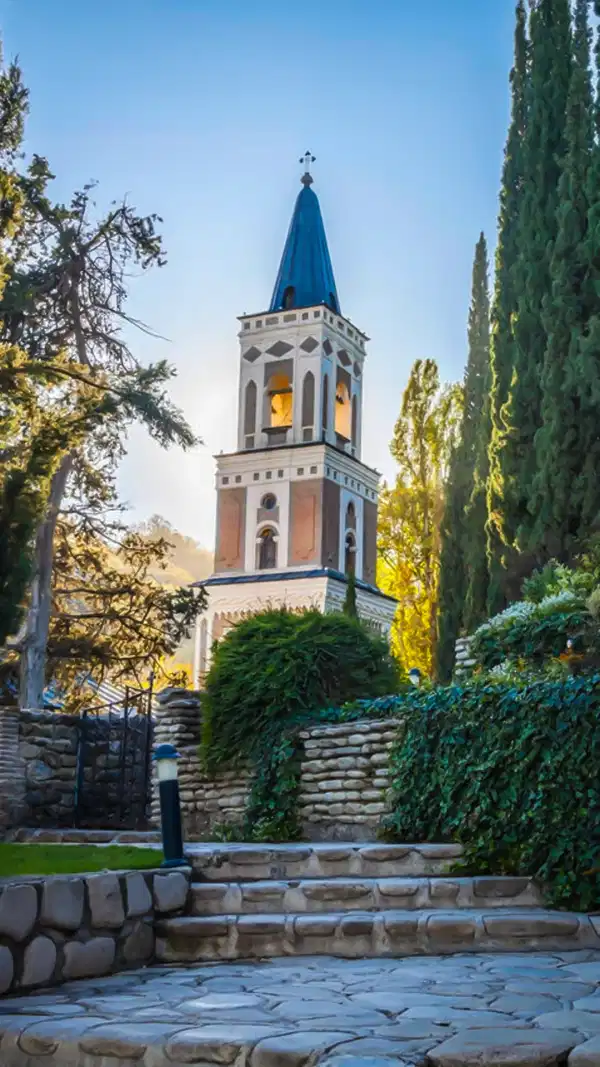
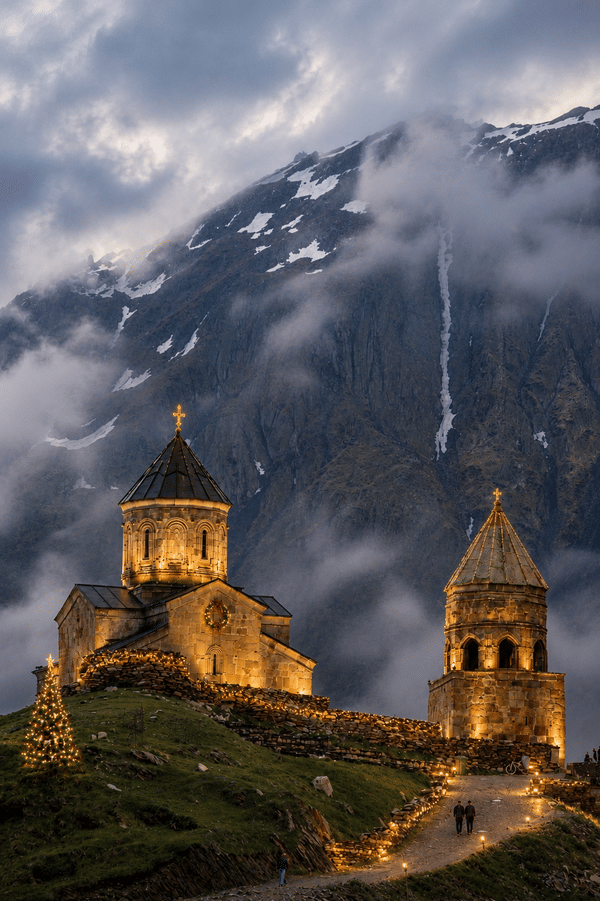
Tbilisi is the rare capital where a 4th-century fortress, a steaming sulfur bath quarter and a glass bridge sit within one afternoon's walk. The best places to visit in Tbilisi, Georgia, are Narikala Fortress, the Abanotubani sulfur baths, Kartlis Deda, Old Tbilisi and Sololaki, Metekhi Church, Sameba Cathedral, Rustaveli Avenue, Mtatsminda Park, and the Chronicle of Georgia.
Twelve of the eighteen attractions in Tbilisi are free to enter, and nine sit within a twenty-minute walk of each other in the Old Town. Three days covers the city comfortably. It's small enough to walk and layered enough that every few hundred meters feels like a different city, and we've taken enough groups through it to know which places land immediately, which ones people wish they'd given more time, and which ones are worth the cab ride out purely because you'll have them to yourself.
Not sure how many of these you'll realistically fit in? Send us your dates and we'll map a route that works. Our Georgia tour packages run on fixed group departures or on your own timeline, whichever suits.
Best Places to Visit in Tbilisi and How Much Time to Give It
1. Narikala Fortress
Narikala Fortress is a 4th-century citadel on the ridge above Old Tbilisi, held in turn by Persians, Arabs, and Mongols, and the single best viewpoint over the city. A Russian gunpowder store detonated inside it in 1827 and destroyed most of what stood. What survives is ruin you can walk into rather than look at, and the last stretch up is uneven stone with no railing before the ridge opens and the whole city drops away below you. It is definitely one of the finest places to see in Tbilisi.
- Entry: Free. Cable car from Rike Park 2.5 GEL each way, Metromoney card only
- Timings: Open 24 hours, unlit at night. Cable car roughly 11 am to 11 pm
- Time needed: 90 minutes, including the walk down
- How to reach: Cable car from Rike Park, or 25 minutes uphill on foot from Meidan Square
Our travel expert's note: Ride up, then walk down the Betlemi stairs. You come out inside the Old Town lanes rather than back across the river, and the descent is the better half of the visit
2. Abanotubani, the sulfur bath quarter
Abanotubani is the sulfur bath district where Tbilisi was founded in the 5th century, built over natural hot springs that still run at 38 to 40°C. King Vakhtang Gorgasali is said to have found the water when his falcon dropped into a spring during a hunt and moved his capital here. You smell it before you see it, and steam seeps up through gaps in the paving as you walk between the low brick domes.
- Entry: Free to walk the quarter. Private bathroom for 60 to 150 GEL an hour, Kisi scrub for 25 to 35 GEL
- Timings: Most bathhouses 9 am to 11 pm
- Time needed: 30 minutes walking, 90 minutes with a bath and scrub
- How to reach: Bottom of the Old Town, 5 minutes downhill from Meidan Square
Our travel expert's note: The smell fades inside two minutes. These domes are the most visited of all the famous places in Tbilisi, so you'll recognize the view before you reach it. Book Chreli Abano a day ahead in summer.
3. Kartlis Deda, the Mother of Georgia
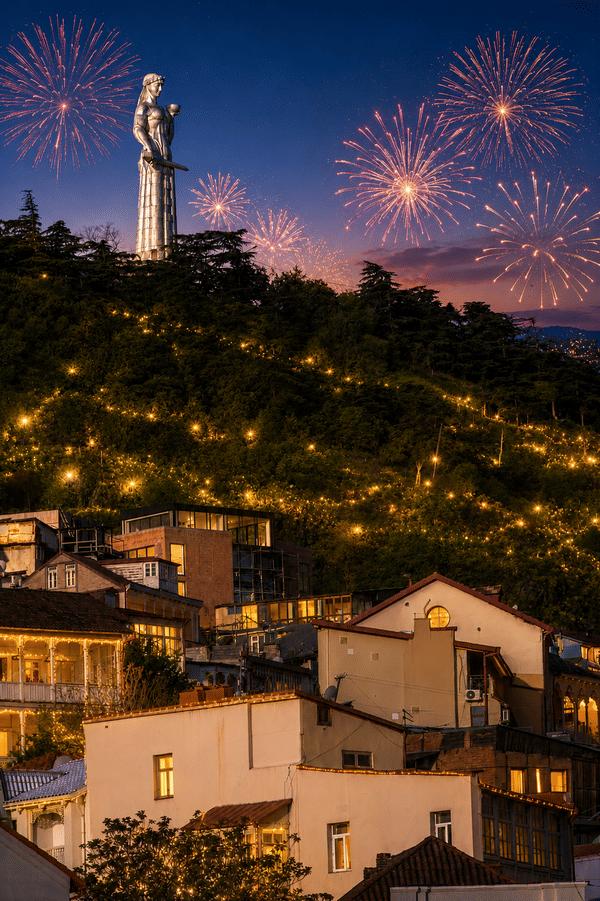
Kartlis Deda is a twenty-meter aluminum statue on the Sololaki ridge, erected in 1958 for the city's 1,500th anniversary, holding a bowl of wine and a sword. Wine for anyone arriving as a friend, sword for anyone who isn't. Elguja Amashukeli's original was wooden and was replaced with aluminum in the 1990s. She's larger than photographs suggest and stands closer to the cliff edge than you expect.
- Entry: Free, no ticket and no gate
- Timings: Open 24 hours, unlit after dark
- Time needed: 20 minutes, plus the 10-minute ridge walk from Narikala
- How to reach: Paved ridge path from Narikala Fortress, no real gradient
Our travel expert's note: Marked as one of the top sights in Tbilisi. Come an hour before sunset when the valley turns copper and she stays in silhouette
4. Old Tbilisi and the Sololaki lanes
Old Tbilisi and Sololaki are the oldest parts of the city and the ones most people enjoy the most. The streets are narrow, the buildings are old and largely unrestored, and almost every block has a shared courtyard behind a gate that's worth pushing open. Wooden balconies lean out over the lanes, staircases curl up through open yards, and the whole quarter has the feeling of a place that has been lived in continuously for a very long time. There is no single thing to see here. The point is to walk slowly, look up and let it take the time it takes.
- Entry: Free
- Timings: Daylight hours for courtyards, which are private property
- Time needed: 90 minutes with no fixed route
- How to reach: Start at Gudiashvili Square, 10 minutes from the Freedom Square metro
Our travel expert's note: Of all the places to explore in Tbilisi, this one punishes planning. Look up, because the best facades sit above eye level. Lado Asatiani and Amaghleba Streets have the densest concentration
5. Metekhi Church and the Vakhtang Gorgasali statue
Metekhi Church is a 13th-century church on the cliff above the Mtkvari, built on the site of the 5th-century royal palace, with a bronze statue of the city's founder beside it. It served as Russian barracks, then a Soviet prison that held Maxim Gorky, then a theater, before returning to use as a church in 1988. The terrace outside gives the best composition in the city.
- Entry: Free
- Timings: Roughly 9 am to 8 pm, closed to visitors during services
- Time needed: 30 minutes, most of it on the terrace
- How to reach: 10 minutes on foot from the sulfur baths across Metekhi Bridge
Our travel expert's note: Among the historical places to visit in Tbilisi, this one has the strangest afterlife. Get there before nine, when the terrace is empty and the sun comes over the ridge behind you
6. Sioni Cathedral
Sioni Cathedral is one of the oldest churches in the city, right in the middle of the Old Town, which makes its quiet interior all the more surprising. It holds a relic that is important to Georgians, a small cross made from grapevines, kept in a case near the altar. The interior is dim and cool, with thick stone walls that block out the street completely. After the open squares and busy lanes outside, walking in feels like the city has been switched off.
- Entry: Free
- Timings: Roughly 8 am to 8 pm, services most mornings and Sunday
- Time needed: 20 minutes
- How to reach: Sioni Street in the Old Town, 3 minutes from Meidan Square
Our travel expert's note: Come on a weekday morning outside service hours. Shoulders and knees covered, and carry a scarf, because Sioni is one of the churches that doesn't reliably keep wraps by the door
7. Anchiskhati Basilica
Anchiskhati Basilica is the oldest surviving building in Tbilisi, built in the 6th century by King Dachi, son of the city's founder. It's a three-nave basilica in plain stone, low and dark, with almost none of the ornament later cathedrals accumulated. Your eyes take a moment when you walk in, and after the larger churches the silence lands differently. Soaking in the peaceful vibes here is one of the top things to do in Tbilisi.
- Entry: Free
- Timings: Roughly 9 am to 7 pm
- Time needed: 15 minutes
- How to reach: Shavteli Street, 4 minutes from Sioni, beside the Gabriadze clock tower
Our travel expert's note: If the choir is rehearsing when you walk in, stay. Anchiskhati's polyphonic ensemble is among the best known in Georgia, and hearing it inside a 6th-century room isn't something you can plan for.
8. Sameba Cathedral
Sameba Cathedral sits on a hill above the city and is the largest church in Georgia. It was built in the 1990s and consecrated in 2004. From almost anywhere in Tbilisi, you can see it on the skyline, which gives you a sense of how big it is before you get there. Standing inside it is a different experience entirely. The dome is so high that the interior feels closer to an open square than a room, and most people spend a few minutes just looking up.
- Entry: Free
- Timings: Roughly 8 am to 8 pm; gardens open later
- Time needed: 40 minutes including the grounds
- How to reach: Elia Hill in Avlabari, 15 minutes uphill from the Avlabari metro or a 10 GEL
Our travel expert's note: Pair it with Metekhi, as both are on the same bank, saving you a river crossing. Late afternoon is when the gardens are worth sitting in
9. Rustaveli Avenue and Freedom Square
Rustaveli Avenue is Tbilisi's main boulevard, laid out by the Russian administration in the 1850s, running from Freedom Square past Parliament, the Opera House, and the Rustaveli Theatre. Every significant moment in modern Georgian politics has happened on this street, from the April 1989 massacre to the 2003 Rose Revolution. The architecture shifts from imperial ornament to hard Soviet civic within a few blocks.
- Entry: Free
- Timings: Any time. Shops and cafes roughly 10 am to 10 pm
- Time needed: 30 minutes end-to-end on foot
- How to reach: Freedom Square metro at one end, Rustaveli metro in the middle
Our travel expert's note: Walk it rather than riding through. Most of the significant Tbilisi tourist attractions on this bank are on or just off this single street.
10. The Georgian National Museum
The Georgian National Museum has two parts, and they feel nothing like each other. The ground floor holds old gold and archaeological finds that most people walk through quickly on their way upstairs. The upper floor is where the visit actually lands. It covers Georgia's Soviet period in a single long room, and it is heavy going in the best possible way.
There is a railway wagon at the entrance, display cases with personal belongings, and a wall that records the names of people who were killed. Most groups go quiet in there and stay quiet for a while after they come out.
- Entry: Around 15 GEL
- Timings: Roughly 10 am to 6 pm, closed Mondays
- Time needed: 90 minutes across both floors
- How to reach: On Rustaveli Avenue, 3 minutes from the Rustaveli metro
Our travel expert's note: Give the treasury ten minutes on your way in, not out, because you won't want to browse gold after the upper floor.
11. The Bridge of Peace and Rike Park
The Bridge of Peace is a glass-and-steel footbridge over the Mtkvari River. It opened in 2010 and connects Rike Park on one side to the Old Town on the other. The walk across takes about three minutes. After dark, lights built into the railings switch on and run a short sequence every hour. It is one of the easiest ways to cross the river on foot, and you will probably use it several times without planning to.
- Entry: Free
- Timings: Open 24 hours, light sequence hourly after sunset
- Time needed: 15 minutes, and you'll cross it more than once
- How to reach: Links Erekle II Street to Rike Park, where the cable car station sits
Our travel expert's note: It connects two clusters of Tbilisi attractions so you'll cross repeatedly anyway. Make one crossing the twenty minutes after sunset, walking Old Town to Rike so the light is behind you
12. Mtatsminda Park
Mtatsminda Park sits at 770 meters above Tbilisi, reached by a funicular running since 1905, and is the highest accessible point in the city. There's an amusement park at the top, a Ferris wheel set on the actual cliff edge, and the widest view anywhere in Tbilisi. The Mtatsminda Pantheon on the slope below holds most of Georgia's major writers, along with Griboyedov.
- Entry: Funicular 15 to 20 GEL return, including the card, park rides charged separately
- Timings: Funicular roughly 9 am to 4 am
- Time needed: 2 hours, half a day with the Pantheon
- How to reach: Funicular from Chonkadze Street, 15 minutes uphill from Rustaveli metro
Our travel expert's note: This is one of the must-visit places in Tbilisi which even couples rate highest. Go ninety minutes before sunset so you get the ridge in daylight and the city lit on the way down
13. The Chronicle of Georgia
The Chronicle of Georgia is a set of sixteen enormous bronze pillars standing on a hill above a reservoir on the outskirts of the city. Each one is about thirty metres tall, covered in carved figures from top to bottom. Nothing about the approach prepares you for their scale. You come around the hill and they are simply there, with no fence, no entrance queue and usually no other visitors.
The wind comes off the water, the pillars catch whatever light is available, and the whole place has the feeling of something that was built and then forgotten about. It is one of the most striking things in Tbilisi and one of the least visited. The Bolt fare out is worth every lari.
- Entry: Free. Bolt out and back around 25 to 30 GEL total
- Timings: Open 24 hours
- Time needed: 1 hour on site, plus 30 to 40 minutes travel each way
- How to reach: Roughly 10 km north of the centre. Have your driver wait, since return Bolts up there take a while
Our travel expert's note: Of all the Tbilisi tourist places our groups photograph, this is the one they'd never heard of before arriving and the one they post first
14. Legvtakhevi Waterfall
Legvtakhevi is a twenty-meter waterfall inside a gorge behind the Abanotubani bath quarter, reopened to the public by a 2012 cleanup after decades as a dumping ground. A wooden walkway runs up to a platform at the base. It sits four minutes from the busiest photo spot in Tbilisi, and you'll often be the only person there. You hear the waterfall sound before the walkway turns and reveals it.
- Entry: Free
- Timings: Daylight hours, strongest flow in spring after snowmelt
- Time needed: 20 minutes end to end
- How to reach: Follow the path past the bathhouses and the mosque, and keep going where it looks like it dead ends
Our travel expert's note: Go straight after Abanotubani. In July and August the gorge runs ten degrees cooler than the street, which alone justifies the detour
15. The Dry Bridge Market
The Dry Bridge Market is an open-air flea market that began in the early 1990s, when the Soviet collapse left people selling household possessions to survive, and much of the stock still dates from that period. Zenit cameras, Red Army medals, porcelain, silver, vinyl, and oil paintings sold by the people who painted them spread across folding tables under the trees.
- Entry: Free, cash only. Open at half the asking price and settle near two-thirds.
- Timings: Roughly 10 am to 5 pm daily, busiest at weekends
- Time needed: An hour browsing, longer if you start buying
- How to reach: Beside the Dry Bridge on the left bank, 8 minutes from the Rustaveli metro
Our travel expert's note: Bring small notes, since nobody breaks a 100 GEL. Our guide to shopping in Georgia covers what's genuinely worth the luggage space
16. Fabrika
Fabrika is a Soviet sewing factory in Marjanishvili, empty for two decades after independence and converted in 2016 into a hostel and cultural venue wrapped around its original courtyard. Bars, a bakery, a bookshop, tattoo studios, and design workspaces fill the surrounding units. Push through the entrance, and the courtyard opens up with a few hundred people in it, and by nine at night this is where the city's under-30s actually are.
- Entry: Free, no cover charge and no door policy
- Timings: Courtyard open all day, busiest 9 pm to 2 am
- Time needed: An evening
- How to reach: Ninotsminda Street, one metro stop from Rustaveli, then 5 minutes on foot
Our travel expert's note: Nothing here is gated, so you can sit on a bench and buy nothing. Good option for solo travellers, since the shared tables make conversation happen without effort
17. Turtle Lake and the Open Air Museum of Ethnography
The Open Air Museum of Ethnography opened in 1966 and holds around seventy traditional Georgian buildings, relocated piece by piece from every region of the country, on the wooded hillside above Turtle Lake. Svan defensive towers, Kakhetian cellars with qvevri still sunk into the floor, and Adjarian timber houses, each furnished as it would have been. The cable car from Vake Park takes you from traffic to pine forest in four minutes.
- Entry: Small museum fee, cable car around 3 GEL each way
- Timings: Museum roughly 10 am to 6 pm, closed Mondays
- Time needed: Half a day for both
- How to reach: Cable car from Vake Park, or a 12 GEL Bolt. The museum is 15 minutes on foot from the lake
Our travel expert's note: The Svan towers are the closest you'll get to upper Svaneti without an eight-hour drive. Save this for the day after the Old Town Hills
18. The Gabriadze Clock Tower
The Gabriadze Clock Tower is a small, slightly crooked tower in the Old Town built by the puppeteer who runs the theatre next door. On the hour, a little angel comes out near the top and strikes a bell. Twice a day, at noon and seven in the evening, a short puppet show plays out in the upper window. It runs for about sixty seconds and tells the story of a life from beginning to end.
People tend to gather at the corner a few minutes before without quite knowing why, and then the window opens and everyone watches in silence. It is free, it takes almost no time, and it is one of those things that is difficult to explain but easy to remember.
- Entry: Free
- Timings: Angel strikes hourly; puppet show at noon and 7 pm
- Time needed: 5 minutes, plus however long you wait for the hour
- How to reach: Shavteli Street in the Old Town, directly beside Anchiskhati Basilica
Our travel expert's note: Take the 7 pm show over noon since the light is better and the lanes come alive right after. The corner is narrow, so arrive five minutes early
Places to Visit Near Tbilisi on a Day Trip
With one free day, take Kazbegi. The road climbs through the Gudauri pass with the Caucasus opening on both sides, and the final stretch to Gergeti needs a 4x4 arranged down in Stepantsminda village. For where the trip should go beyond the capital, our rundown of places to visit in Georgia covers Batumi through to Svaneti.
How Many Days Do You Need in Tbilisi?
Three days is enough to properly cover the best places to visit in Tbilisi. Two days covers the essentials, and five to six days lets you use the city as a base for Mtskheta, Kazbegi, and the Kakheti wine region.
- Two days runs the Old Town cluster on foot for day one, then Rustaveli, the National Museum, the Dry Bridge Market and Mtatsminda at sunset on day two.
- Three days adds Sameba, the Chronicle of Georgia, Turtle Lake and an evening at Fabrika, and leaves room to lose an hour in Sololaki without paying for it later.
- Five to six days keeps the capital as your base while you drive out each morning.
Which Tbilsi Attractions Should You Prioritise?
How to Move Between These Tbilisi Attractions Without Wasting Time
Most of the places on this list of the best places to visit in Tbilisi are close enough together that you can cover them in a single day on foot without paying for transport once. Everything from the sulfur baths up to Sameba is a matter of choosing which lane to take rather than which cab to book.
Beyond that historic core, the city opens up considerably, and the gradients are steeper than any map suggests, so how you get around starts to matter.
- Metro and cable car: Buy a Metromoney card at any metro station on your first morning. It covers the metro at 1 GEL per ride, the city buses, and the Narikala cable car. The cable car booth does not take cash, so without the card you cannot use it at all.
- Cabs: Install Bolt before you fly. It's the local ride-hailing app, and rides run 5 to 12 GEL across the city, with the fare agreed upon before you get in. Use it for the Chronicle of Georgia, Sameba, and Turtle Lake, which are too far to walk. If you go to the Chronicle, ask your driver to wait. Getting a return ride from that hill takes time.
- Footwear: The Old Town is cobbled and slopes more than it looks on a map. Bring shoes with grip. Every group we take has at least one person who regrets their footwear by lunchtime on day one, usually on the Betlemi stairs.
- Timing: Do the Old Town cluster in the morning before the crowds arrive, then use the afternoon for the sites that need a cab. The busier Tbilisi tourist attractions fill up fast after ten. Save Mtatsminda for the end of the day, since the funicular runs late and coming down after dark is the best way to finish.
For visas, SIM cards, money, and everything else worth sorting before you fly, check out our travel tips for Georgia guide.