Tbilisi stays with you longer than most cities do. It has a fourth-century fortress you can walk up to in half an hour, sulfur springs that have been running since before the city had a name, wooden balcony houses stacked up the hillside above the old town, and a food and wine culture that Indian travellers tend to fall for harder than they expect.
The best things to do in Tbilisi range from soaking in the Abanotubani baths and climbing Narikala to eating your way through the old town and spending an evening in a wine cellar in Kala. Most of it costs very little and none of it requires a plan made more than an hour in advance.
We run Georgia departures through most of the year, and Tbilisi is where almost every itinerary begins and ends. Over those trips we've watched what people actually enjoy versus what merely looks good on paper.
So this guide covers the things to do in Tbilisi, Georgia, with real costs, walking distances, and timing advice, plus a clear sense of what you can skip if you're short on days. Also, if you'd rather have the routing, drivers, and day trips sorted before you land, take a look at our Georgia tour packages, fixed group departures with a trip captain, or a customized itinerary built around your dates.
20 Best Things to Do in Tbilisi (Suggested by WanderOn Travel Experts)
Our travel experts have planned enough Georgia itineraries to know the best order for this city, which sights to see before the crowds arrive, which ones are better skipped for a version two streets away, and where people are actually happiest at the end of a long day.
The list below mentioning the best things to do in Tbilisi follows roughly that sequence, starting in the Old Town where every Tbilisi trip should begin.
1. Book a private room at the Abanotubani sulfur baths
This is the reason the city exists. King Vakhtang Gorgasali is said to have found hot springs here in the 5th century and moved his capital to the spot because "Tbili" means "warm." The bathhouses sit under brick domes that poke out of the ground like beehives, and the water arrives naturally hot and heavily mineralized. It smells exactly as sulfurous as you'd fear for the first ninety seconds, then not at all.
- Cost: 60 to 150 GEL an hour for a private room, depending on which one. Split across four people it works out cheap. The kisi scrub costs another 25 to 35 GEL.
- Best time: Before noon. Rooms fill up after 4 pm and you'll be turned away or made to wait.
- Our advice: Take a private room rather than the public hall. Chreli Abano is the photogenic one with the blue-tiled Persian facade, while Bathhouse No. 5 next door is plainer and cheaper for the same water.
- Don't miss: The kisi scrub. It's considerably more vigorous than you're imagining, and worth it.
2. Ride the cable car up to Narikala Fortress
Narikala has stood in some form since the 4th century, rebuilt in turn by Arabs, Mongols, and Persians, then half ruined by a gunpowder explosion in 1827. What survives is enough to walk through properly, and the ridge it occupies gives you the single widest view over the Mtkvari River and the tin rooftops of the old quarter.
- Cost: 2.5 GEL each way on a Metromoney card, three minutes in the car.
- Best time: Late afternoon, ahead of the sunset crowd. Budget an hour and a half for the whole loop.
- Our advice: Take the cable car up from Rike Park, then walk down the Betlemi stairs instead of riding back. You land directly in the Old Town lanes rather than doubling back across the river.
- Don't miss: The ride itself justifies the fare, so sit facing the river on the way up.
3. Walk the ridge to Kartlis Deda for the best sunset view in the city
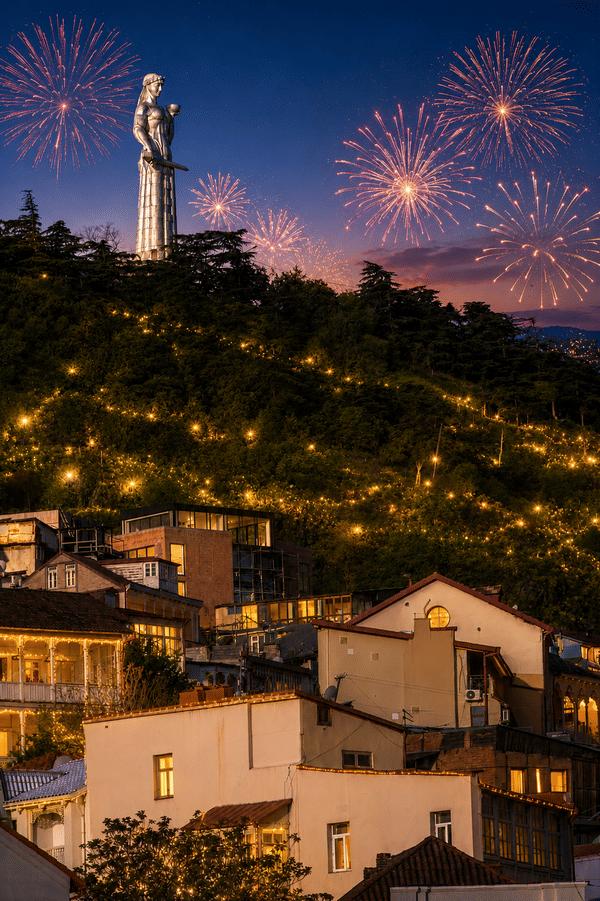
A twenty-meter-long aluminum woman stands above Sololaki, holding a bowl of wine in one hand and a sword in the other. Wine for those who come as friends, sword for those who don't. She went up in 1958 for the city's 1,500th anniversary and has become the shorthand image of Tbilisi ever since.
- Cost: Free. No entry fee and no queue, which is rare for a viewpoint this good.
- Best time: An hour before sunset, when the whole valley turns copper beneath you.
- Our advice: It's a ten-minute walk along the ridge from Narikala on a paved path with no real climb, so do the two together rather than as separate trips.
- Don't miss: She earns her place among the top sights in Tbilisi for the light more than the statue itself.
4. Give ninety unplanned minutes to the Old Town and Sololaki lanes
Sololaki and the streets below Betlemis are where Tbilisi is most itself. Carved wooden balconies sag off 19th-century facades, courtyards have laundry strung across them at three levels, and Art Nouveau doorways stand unrestored in a way that's frankly better than the alternative.
- Cost: Free.
- Best time: Mid-morning, before the heat builds and the tour groups arrive.
- Our advice: Gudiashvili Square works as an anchor point to wander out from in any direction. This is one of the few things to do in Tbilisi that works better without a plan, so take no route, no destination, and push open any courtyard gate already ajar.
- Don't miss: The second-floor facades. Most of the best ones are up there, and you'll walk straight under them if you're watching your feet on the cobbles.
5. Find the Legvtakhevi waterfall hidden behind the bathhouses
A genuine twenty-meter waterfall sits inside a narrow gorge, a five-minute walk past the sulfur baths, and most visitors never find it because the entrance path looks like it dead-ends behind the bathhouses. A wooden walkway runs up the gorge to a viewing platform at the base of the falls.
- Cost: Free, and one of the better free things to do in Tbilisi.
- Best time: Midday in summer. The gorge runs a good ten degrees cooler than the street outside.
- Our advice: Pair it with the sulfur baths, since it's four minutes from the most photographed corner in the city and takes twenty minutes end to end.
- Don't miss: The platform at the base of the falls, where the spray actually reaches you. It's usually near empty.
6. Time your crossing of the Bridge of Peace for twenty minutes after sunset
The glass and steel footbridge over the Mtkvari opened in 2010, designed by an Italian architect, and locals were not universally thrilled about a curved glass canopy landing next to a medieval quarter. It has grown on more or less everyone since, helped considerably by the LED sequence built into the parapet.
- Cost: Free.
- Best time: Twenty minutes after sunset, when the LED sequence fires up.
- Our advice: It connects Rike Park on the left bank straight into the Old Town, linking two clusters of Tbilisi attractions, so you'll cross it several times whether you plan to or not. Just make one of those the evening crossing.
- Don't miss: Metekhi Church on the cliff opposite, still catching the last of the daylight while the bridge lights come on.
7. Climb to Metekhi Church for the photograph everyone is actually chasing
Metekhi sits on the cliff edge directly across the water from the bathhouses, with the bronze statue of Vakhtang Gorgasali beside it, both visible from almost every point in the Old Town. The current church dates to the 13th century, built on the site of the original royal chapel.
- Cost: Free.
- Best time: Early morning gives you the cleanest light and an empty terrace.
- Our advice: The church is small enough to see properly in fifteen minutes. The terrace outside is the real reason to walk up.
- Don't miss: The angle back towards Narikala, the sulfur domes and the river bend. It's the composition most people are after in Tbilisi and you can only get it from this side.
8. Step inside Anchiskhati Basilica and Sioni Cathedral
Anchiskhati dates to the 6th century and is the oldest surviving church in the city. Plain stone, a low ceiling, almost no ornament, and a hush that feels different from the larger cathedrals. Sioni, a few streets away, holds the cross of St. Nino, made from grapevines bound together with her own hair.
- Cost: Free at both.
- Best time: Weekday mornings, when services aren't running and you can actually stand still inside.
- Our advice: Do them together. Between the two you get a real sense of how deep Christianity runs here, since Georgia adopted it in 337 CE, one of the earliest states in the world to do so.
- Don't miss: Carry a scarf. Shoulders and knees covered at both, and while most churches keep a basket of wraps by the door, not all of them do.
9. See Sameba Cathedral, one of the tallest Orthodox churches in the world
Sameba was finished in 2004 and it is enormous, sitting on Elia Hill where it dominates the skyline from every angle. It's unmistakably modern and it looks it, which divides opinion, but nobody argues with the scale once they're standing inside it.
- Cost: Free.
- Best time: Late afternoon, when the gardens around the complex are cool and quiet.
- Our advice: Thirty to forty minutes covers it comfortably. Pair it with Metekhi, since both sit on the same side of the river and you save yourself a crossing.
- Don't miss: The terrace on the approach, which gives you a clear view back across the river to the Old Town ridge.
10. Walk Rustaveli Avenue and stop at the Museum of Soviet Occupation
Rustaveli runs from Freedom Square past the Parliament building, the Opera House and the Rustaveli Theatre, and it's where the modern history of the country has largely played out. The buildings along it move from 19th century imperial to hard Soviet civic in the space of a few blocks.
- Cost: Around 15 GEL for the Georgian National Museum.
- Best time: Morning. Half an hour to walk the avenue end to end, ninety minutes for the museum.
- Our advice: Don't schedule anything cheerful immediately after. It's the most affecting thing you'll see in Tbilisi, and it lands harder than people expect.
- Don't miss: The Museum of Soviet Occupation inside the National Museum, a single long hall covering seventy years of Soviet rule, execution records included.
11. Bargain for Soviet cameras and old silver at the Dry Bridge Market
Every morning, sellers set up folding tables under the trees near the Dry Bridge with Soviet cameras, Red Army medals, chipped porcelain, silver cutlery, vinyl and oil paintings from the people who painted them. Some of it is genuine, some of it is aged in a shed, and sellers are usually cheerfully upfront about which is which if you ask.
- Cost: Whatever you negotiate. Open at roughly half the asking price and settle around two thirds.
- Best time: Before lunch. Traders open around 10 am and the better pieces move early.
- Our advice: Carry small notes, because almost nobody here takes a card. For the full picture on carpets, cloisonné, and wine before you commit luggage space, our guide to shopping in Georgia covers what's worth buying and what isn't.
- Don't miss: The camera tables at the far end, past the paintings, where the Soviet optics are usually stacked.
12. Take the funicular up Mtatsminda ninety minutes before sunset
The funicular climbs from Chonkadze Street to Mtatsminda Park at 770 metres, and the carriage itself is half the appeal. A steep, slow haul up the mountainside with the city dropping away behind you. At the top there's an amusement park, a Ferris wheel positioned right at the cliff edge, and a restaurant with the widest view in the city.
- Cost: Roughly 15 to 20 GEL for the return trip, including the reloadable card.
- Best time: Ninety minutes before sunset, so you get the ridge path in daylight and the city lit on the way down.
- Our advice: This is the one we push hardest when people ask about things to do in Tbilisi for couples, and it costs almost nothing.
- Don't miss: The Ferris wheel at the cliff edge and staying long enough for the city to switch on beneath you.
13. Visit the Chronicle of Georgia
Sixteen bronze-clad pillars, each around thirty metres tall, carved with Georgian kings and queens across the upper half and scenes from the life of Christ across the lower. They stand on an exposed hill above the Tbilisi Sea reservoir, well outside the centre, built by the sculptor Zurab Tsereteli and left curiously off most itineraries.
- Cost: Free entry. A Bolt out-and-back run is about 25 to 30 GEL.
- Best time: Late afternoon, when the low sun catches the bronze.
- Our advice: Of all the unique things to do in Tbilisi, this is the one our travellers photograph most and hadn't heard of before they arrived.
- Don't miss: The view down over the reservoir through the gap between the pillars. You'll often have all sixteen entirely to yourself.
14. Ride 150 metres down the escalator at Rustaveli metro station
The metro here was built deep, for reasons that were as much about civil defence as engineering, and the escalator at Rustaveli station drops roughly 150 metres, among the deepest in the world. The descent takes close to three minutes, in a tiled tube, with a wind coming up from below.
- Cost: 1 GEL on the Metromoney card.
- Best time: Outside rush hour, when you can stand still and take it in.
- Our advice: It's also the cheapest way to move between Tbilisi tourist attractions on opposite sides of the centre. Ride down, take the train one stop to Marjanishvili, and you're at the doorstep of Fabrika.
- Don't miss: Stand right, walk left. Locals actually enforce it.
15. Spend a free evening in the Fabrika courtyard
Fabrika is a Soviet-era sewing factory in Marjanishvili, rebuilt as a hostel wrapped around a large open courtyard, with bars, a bakery, a bookshop, tattoo studios and design workspaces filling the surrounding units. By nine in the evening the courtyard is full of local students, designers and travellers, and it stays that way well past midnight.
- Cost: Free to walk in. No cover charge and no door policy.
- Best time: After nine, once the courtyard fills up properly.
- Our advice: For a first pass at things to do in Tbilisi at night, this is the gentlest possible entry point, with a reasonable chance of ending up in conversation with someone who lives here.
- Don't miss: Nothing about it is gated. You can walk in, sit on a bench and buy nothing at all.
16. Go out properly at Bassiani, but register online before you fly
Bassiani is the one with the international reputation. A techno club in the drained swimming pool beneath Dinamo Arena, with a serious sound system, a proper door policy and a place in Georgian political history after the 2018 raids and the protest rave outside Parliament.
- Cost: Varies by night. Registration online is free but has to be done in advance.
- Best time: Friday or Saturday, doors late.
- Our advice: Register well ahead, because walk ups are turned away regularly. If that's more commitment than you want, KHIDI under a bridge on the left bank is more forgiving on the door, Dedaena Bar by the river draws the skate and craft beer crowd, and the wine bars along Erekle II Street pour until midnight without any of the drama.
- Don't miss: The cheapest late option in the city is still the Narikala cable car after dark.
17. Taste qvevri wine, made the same way for 8,000 years
Georgia has been making wine for roughly eight millennia, fermented in clay qvevri buried underground, a method now on the UNESCO intangible heritage list and still used by families across Kakheti. Amber wine made this way, with the skins left in, tastes nothing like white wine as you know it. It's tannic, dry, faintly nutty, closer in structure to a light red.
- Cost: From about 40 GEL per person for a structured tasting.
- Best time: Early evening, before dinner.
- Our advice: Vino Underground and 8000 Vintages both run proper tastings with an hour of actual explanation rather than four glasses and a shrug. It's one of the things to do in Tbilisi Georgia that people book last and rate first.
- Don't miss: Ask specifically for a Rkatsiteli and a Saperavi to understand the two ends of the range. If homemade chacha appears afterwards, remember it's often over 50%.
18. Learn to eat khinkali properly, and say yes if you're invited to a supra
Khinkali are soup dumplings twisted into a knot at the top. Hold the knot, bite a small opening, drink the broth first, eat the rest, and leave the knot on your plate. Counting knots is how Georgians keep score at the table. Adjarian khachapuri is the boat shaped bread with an egg and a slab of butter dropped into molten cheese, and one of them comfortably feeds two.
- Cost: 1 to 2 GEL per khinkali. Adjarian khachapuri runs around 15 to 20 GEL.
- Best time: Late lunch, when kitchens aren't slammed and the dumplings come out faster.
- Our advice: Salobie Bia and Keto and Kote are both reliable. Vegetarians do unusually well here thanks to Orthodox fasting traditions, so badrijani nigvzit, lobio in a clay pot, pkhali and mushroom khinkali are proper dishes rather than substitutions.
- Don't miss: A supra, if anyone invites you. A tamada runs the toasts in a fixed order and it's the closest you'll get to the actual social life of the country.
19. Give your legs a day off at Turtle Lake and the Ethnography Museum
A cable car from Vake Park lifts you to a small lake ringed with walking paths, cafes and a swimming area, twenty minutes from the centre and several degrees cooler. It's the standard local escape on a hot afternoon, and after three days of cobbled hillsides your legs will make the case for it before you do.
- Cost: Modest cable car fare, plus a small entry fee at the museum.
- Best time: A hot afternoon, or the day after you've walked the Old Town hills.
- Our advice: The best break in a week of Tbilisi sightseeing, and half a day covers the lake and the museum together comfortably.
- Don't miss: The Open Air Museum of Ethnography on the same wooded hillside, with Svan tower houses, Kakhetian wine cellars and Adjarian timber homes relocated piece by piece from every region of Georgia.
20. Catch the 7 pm puppet show at the Gabriadze Clock Tower
A deliberately crooked, tiled, faintly unhinged little tower stands beside Rezo Gabriadze's puppet theatre in the Old Town, built by the puppeteer himself out of salvaged material. On the hour, a small angel emerges from a door near the top and strikes a bell with a hammer.
- Cost: Free.
- Best time: 7 pm rather than the noon show. Better light, and the surrounding tourist places in Tbilisi are at their best straight after.
- Our advice: Arrive five minutes early. The corner is narrow and fills up fast once people realise what's about to happen.
- Don't miss: The Circle of Life, the longer puppet sequence that plays in the upper window at noon and 7 pm. Birth to death in about sixty seconds.
How to Fit Things to Do in Tbilsi Into 2 or 3 Days
Two days covers the core, tightly. Day one: Old Town, sulfur baths, Narikala, Kartlis Deda, and Bridge of Peace, all walkable. Day two: Rustaveli, the National Museum, Dry Bridge Market, and Mtatsminda at sunset. You'll see the main Tbilisi tourist attractions, but you'll feel rushed.
Three days is the sweet spot. A third day fits Sameba, the Chronicle of Georgia, a wine tasting, and an evening at Fabrika and lets you lose an hour in Sololaki without falling behind.
Beyond three days, use the city as a base and drive out, because the tourist places in Tbilisi start repeating while Mtskheta sits 25 km away, Kazbegi 155 km, and Kakheti 110 km. That's how we build our Georgia itineraries. For where else the trip should go, our rundown of places to visit in Georgia covers Batumi through to Svaneti.
Traveling Between These Sights: Metro Cards, Bolt Fares and Cobbled Hills
Entries 1 to 8 are walkable in a day without a cab. Past the historic core the city spreads out, and the hills are steeper than the map lets on.
- Buy a Metromoney card at any metro station on your first morning. A couple of lari, reloadable, and it works on the metro, buses, and the Narikala cable car, which takes most of the friction out of a day of Tbilisi sightseeing.
- For anything outside the center like the Chronicle, Sameba, or Turtle Lake, get Bolt before you land. Rides run 5 to 12 GEL, and it saves haggling with the taxis parked outside the busier Tbilisi tourist attractions.
- On footwear: this city is built on hills, and the Old Town is cobbled and uneven. Bring shoes with grip. For visas, SIMs, money, and the rest, our travel tips for Georgia guide handles the practical side.