Meghalaya is an offbeat, nature-based destination tucked in Northeast India, built for adventure, eco-tourism, and slow travel. Spanning misty highland plateaus, deep river gorges, and dense subtropical forests, it’s the kind of place that rewards curiosity over comfort. This is a complete Meghalaya tourism guide for planning your journey.
Meghalaya tourism brought over 18 lakh visitors in 2025 and once you see it yourself the numbers will start making sense. It's home to living root bridges grown over centuries, the world's wettest places at Mawsynram and Cherrapunji, the impossibly clear Umngot River, and limestone cave systems among the longest in Asia. So, if you're recently thinking about a Meghalaya trip, this is your sign.
This Meghalaya tourism guide covers everything you need including when to go, where to stay, and what to prioritise. You can also check out Meghalaya tour packages for curated group and private trips to the region.
Destination Snapshot: Know Before You Go
Detail
Information
Capital
Shillong
Official Languages
English, Khasi, Garo, Jaintia
Currency
Indian Rupee (INR)
Time Zone
IST (UTC +5:30)
Best Time to Visit
October to April
Nearest Major Airport
Guwahati (approx. 120 km from Shillong)
SIM & Mobile Networks
Airtel and Jio have the widest coverage; BSNL works in remote areas
Visa (Foreign Nationals)
Standard Indian Tourist Visa required; Inner Line Permit not required for most areas
Forex
Exchange USD/EUR in Shillong city; ATMs available in Shillong and Cherrapunji; carry cash for remote areas
Emergency Number
112 (National Emergency)
Info
Visa Note for International Travelers: Most foreign nationals require a standard Indian Tourist Visa to visit Meghalaya. Citizens of Pakistan, Bangladesh, and a few other nationalities require additional permissions. The Protected Area Permit (PAP) is needed only for certain restricted border zones, like Nongkhlaw, Nongjri, and areas along the sensitive India-Bangladesh border in South Garo Hills, not for mainstream tourist destinations. Always verify current requirements with the Indian embassy in your country before travel. This is a key part of any good Meghalaya tourism guide.
Best Time To Visit Meghalaya
October to April is the best time to visit Meghalaya. It's the time when monsoon has left with lush landscapes and no daily downpour. Winter brings pleasant, clear days perfect for treks, viewpoints, and village walks.
Season / Months
Weather & Temperature
Best For
Activities & Festivals
October to November
18°C to 24°C, post-monsoon
Waterfalls, greenery, fewer crowds
Cherrapunji viewpoints, Dawki, Nongriat trek, Nongkrem festival
December to February
8°C to 18°C, cool and dry
Sightseeing, trekking, clear skies
Shillong city, Laitlum sunrise, Mawlynnong, Wangala festival
March to April
18°C to 26°C, warming up
Road trips, offbeat exploration
Jaintia Hills, Balpakram, Shnongpdeng camping, Behdienkhlam
May to September
20°C to 28°C, heavy monsoon
Rainfall photography, monsoon chasers
Mawsynram, Cherrapunji; most treks not advisable
How To Reach Meghalaya
Meghalaya has good connectivity via air, train, and road. Here are a few excellent ways to reach Meghalaya.
By Air
Primary gateway: Lokpriya Gopinath Bordoloi International Airport, Guwahati (IATA: GAU), approx. 120 km from Shillong
Airlines: IndiGo, Air India, SpiceJet, Akasa Air
Direct flights from: Delhi, Mumbai, Kolkata, Bengaluru, Chennai, Hyderabad
Guwahati to Shillong: Private cab (INR 1,500 to 2,500) or shared taxi from Paltan Bazar (INR 200 to 300 per seat); travel time 3 to 4 hours, making Guwahati the natural starting point for most Meghalaya trips
Alternate airport: Umroi Airport, Shillong (IATA: SHL), approx. 35 km from city center; limited IndiGo connectivity from Kolkata only
By Train
Nearest railhead: Guwahati Junction (GHY); no direct rail connection into Meghalaya
From Delhi: Rajdhani Express or Saraighat Express (approx. 36 hours)
From Kolkata: Saraighat Express or Kamrup Express (approx. 17 to 18 hours)
From Mumbai: Northeast Express (approx. 48 hours)
Guwahati to Shillong: Private cab or shared taxi, 3 to 4 hours
By Road
From Guwahati (Most Common Route)
Route: NH6 (NH-106), Guwahati to Shillong; approx. 100 km
Travel time: 3 to 4 hours. The road journey is a highlight of any Meghalaya trip from Guwahati.
Shared taxi: Departs Paltan Bazar, Guwahati; INR 200 to 300 per seat
Private cab: INR 1,500 to 2,500 from airport or city
State buses: ASTC and MSRTC operate on this route
From Other Northeast Cities
Silchar to Shillong: Approx. 220 km via NH6; travel time 6 to 7 hours
Dimapur to Shillong: Approx. 330 km via NH29 and NH6; travel time 8 to 9 hours
Agartala to Shillong: Approx. 450 km via NH8 and NH6; travel time 10 to 12 hours
Aizawl to Shillong: Approx. 500 km; travel time 12 to 14 hours
From Kolkata (Long-Haul)
Route: NH12 via Siliguri, then NH17 to Guwahati, continuing NH6 to Shillong; approx. 1,000 km
Travel time: 20 to 24 hours; not recommended as a single stretch
Better option: Fly or take a train to Guwahati, then drive to Shillong
For a detailed breakdown of flights, trains, and road travel options, our guide on how to reach Meghalaya has you covered.
Top Scenic Places To Visit In Meghalaya
Key tourist places in Meghalaya worth building your itinerary
Shillong: The state capital and most popular base. Key places to visit in Shillong include Police Bazar, Ward's Lake, Elephant Falls, Shillong Peak, and the Don Bosco Museum. The cafe and live music scene makes evenings here worth planning around.
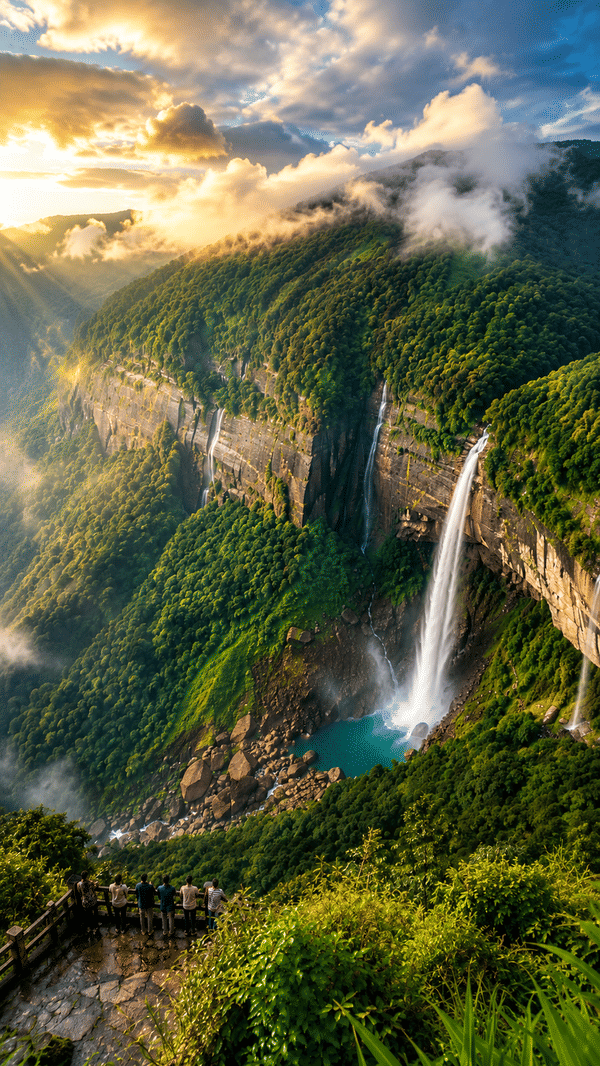
Cherrapunji (Sohra): One of the wettest places on earth, with dramatic viewpoints, Nohkalikai Falls (India's tallest plunge waterfall at 340 m), Seven Sisters Falls, and Mawsmai Cave. Many popular places to visit in Cherrapunji, like the double-decker living root bridges, are close by.
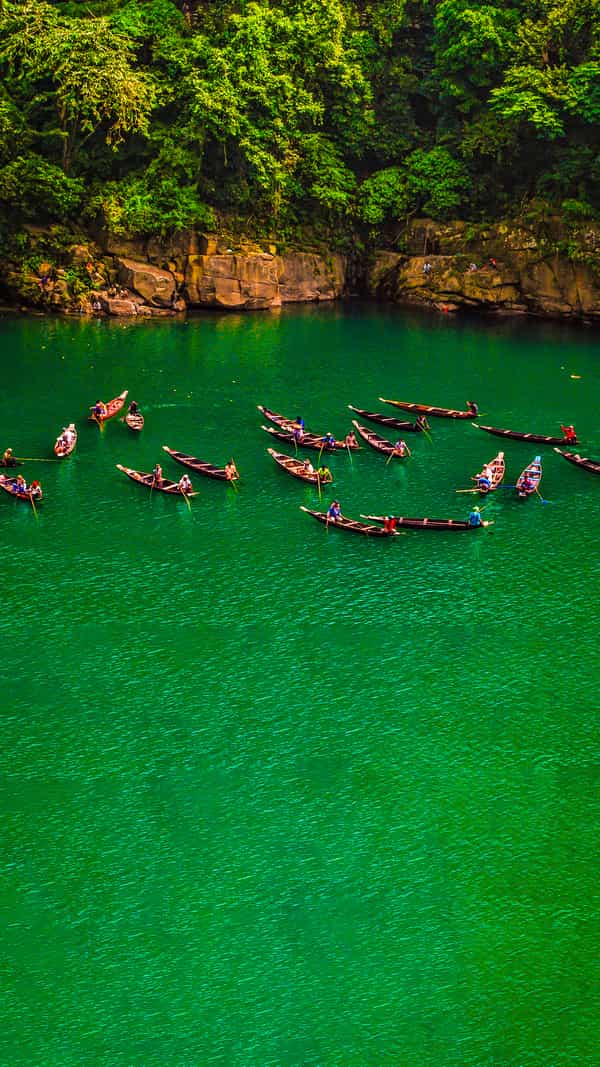
Dawki: A small border town on the Umngot River where the water is clear enough to make boats look like they're floating on glass. Riverside camping is possible and worth it.
Mawlynnong: Asia's cleanest village, run entirely by the local Khasi community near the Bangladesh border. The bamboo sky walk gives clear-day views across into Bangladesh.
Nongriat: Reached via a steep 3,500-step trek from Tyrna, this village is home to the famous double-decker living root bridge. An overnight stay is strongly recommended.
Mawphlang Sacred Forest: A 78-hectare ancient forest preserved by Khasi tradition, where no plant or animal may be removed. Guided walks here are genuinely eerie and beautiful.
Mawsynram: Holds the record for the highest average annual rainfall on earth. Quieter than Cherrapunji, with fewer crowds and a rawer monsoon landscape.
Elephant Falls: A three-tiered waterfall on the outskirts of Shillong, easy to combine with a city day. Named by the British after a rock that no longer exists.
Tura and Balpakram National Park (Garo Hills): Meghalaya's western district feels like a different world, tropical forests, wildlife like elephants and clouded leopards, and barely any tourist crowds.
Jowai and Nartiang (Jaintia Hills): Far less visited but worth the detour, ancient monolith fields, Krang Suri Falls, and authentic Jaintia culture with almost no tourist trail.
For route ideas beyond the standard circuit, places to visit in Meghalaya is a solid starting point. Head west into the Garo Hills (Tura and Balpakram National Park are the anchors) and you'll find a different Meghalaya altogether: tropical forests, wildlife, and far fewer people.
Offbeat Places In Meghalaya
Beyond the well-known circuit, Meghalaya has a quieter side that most travelers never reach. These spots reward the effort with fewer crowds, more genuine interactions, and landscapes that feel untouched.
Shnongpdeng: A village on the Umngot River, 4 km away from Dawki, known for camping, kayaking and snorkelling in the crystal clear water. Much quieter than Dawki during peak season.
Laitlum Canyons: These dramatic gorges near Shillong are often referred to as the Grand Canyon. It’s hard to beat the sunrise here and most mornings you’ll find the place almost to yourself.
Kongthong (Whistling Village): In this remote Khasi village, every resident has a unique tune, hummed by their mother at birth, used in place of a name. Easily one of the most unusual cultural experiences in Northeast India.
Nohsngithiang (Seven Sisters Falls): Visible from a viewpoint near Cherrapunji, this seven-segmented waterfall is best visited during or just after monsoon when all streams are in full flow.
Phe Phe Falls: A short trek from Jowai in the Jaintia Hills, tucked inside a deep gorge and largely off the mainstream tourist trail.
Wei Sawdong Falls: A three-tiered waterfall near Cherrapunji, reached after a short walk through forest cover. The natural pool at the base is one of the best swimming spots in the region.
Mawryngkhang Bamboo Trek (Wahkhen Village): A narrow bamboo bridge trail over the Umiam River gorge near Nongstoin. The trek involves walking on bamboo poles suspended over a deep ravine, not for the faint-hearted.
Ranikor: A remote riverside village in South West Khasi Hills, accessible via a long drive through forest roads. Known for river camping and near-zero tourist footfall.
If you want to go past the usual highlights, a Meghalaya road trip opens up the state nicely, especially when the roads are dry. This is a state built for slow road-trips, scenic stretches, sudden viewpoints, and detours that turn into the day's best memory. For a deeper look, the offbeat places in Meghalaya guide covers these and more in detail. A good Meghalaya tourism guide will always include a mix of popular and offbeat spots.
Best Things To Do In Meghalaya For Every Traveler
1. Trekking to the Living Root Bridges (Nongriat): The double-decker living root bridge near Nongriat means a 3,500-step descent from Tyrna, about 45 to 90 minutes one way. Added to UNESCO's tentative World Heritage list in 2022, these are living structures shaped over centuries by the War Khasi people, and they only get stronger with time.
2. River Camping at Shnongpdeng and Dawki: The Umngot River is clear enough to see the riverbed 10 feet down, which makes camping along its banks a completely different experience. Set up a tent at Shnongpdeng, kayak over water that shifts from turquoise to silver as the light changes, there's nothing quite like it in India.
3. Chasing Waterfalls, Nohkalikai, Wei Sawdong, and Beyond: At 340 m, Nohkalikai is India's tallest plunge waterfall and the obvious highlight. But the region has plenty more, Rangsohkham Falls and Kshaid Thum Waterfall in the Jaintia Hills are the kind of places that haven't made it onto crowded itineraries yet.
4. Walking the Mawphlang Sacred Forest: Khasi tradition has protected this 78-hectare forest for centuries, nothing leaves, not a leaf or a stone. Guided walks carry a rare stillness, part ecological wonder, part living cultural archive.
5. Exploring Mawlynnong and the Sky Walk: Asia's cleanest village runs entirely on community-led eco-tourism. The bamboo sky walk at the village edge gives clear-day views across the Bangladesh plains, something most travelers don't expect.
6. Caving at Mawsmai and Krem Liat Prah: Meghalaya holds some of the longest cave systems in the subcontinent. Mawsmai Cave near Cherrapunji is well-lit and easy to walk through; Krem Liat Prah in the Jaintia Hills, one of the longest natural caves in Asia, is a different story and better suited for serious spelunkers.
7. Road-Tripping Through the Jaintia Hills: The Shillong to Jowai drive is one of Northeast India's most underrated stretches. Monolith fields at Nartiang, the turquoise pool at Krang Suri Falls, and the gorge at Phe Phe Falls, all on a route that sees a fraction of the traffic Cherrapunji gets.
8. Experiencing Kongthong, the Whistling Village: Every person in this remote Khasi village is given a unique melody at birth, used as their name in everyday life. One of the most quietly extraordinary cultural traditions in the country, nothing else on a Northeast India trip quite compares.
9. Sunrise at Laitlum Canyons: Often compared to a miniature Grand Canyon, these gorges near Shillong are best seen before dawn. Get there early and you'll likely have the viewpoint to yourself, mist filling the valley below and the first light laying across the ridgelines in layers.
10. Attending a Local Festival: Meghalaya's tribal festivals are among the most visually striking in India. Nongkrem (Khasi), Wangala (Garo), and Behdienkhlam (Jaintia) each bring traditional dance, music, and ritual, real cultural depth that goes well beyond the usual sightseeing circuit.
Food In Meghalaya
The food in Meghalaya is rooted in simplicity and strong local ingredients: smoked meats, fermented flavors, sticky rice, and broths that carry real depth. The cuisine spans three distinct communities (Khasi, Garo, and Jaintia), each with its own staples, but pork, rice, and bold umami notes run through all of them.
Top Meghalayan Dishes
Jadoh: Khasi pork and rice cooked together with spices; the most iconic dish in the state
Doh-Khlieh: Cold minced pork salad with onion, green chili, and ginger; sharp and refreshing
Tungrymbai: Fermented soybean paste; pungent, earthy, served as a side or condiment
Nakham Bitchi: Dried fish soup; warming and deeply umami
Wak Pura: Garo-style slow-cooked pork with local herbs
Minil Songa: Sticky rice steamed in bamboo; common at festivals and village meals
Top Places To Eat In Meghalaya
Jadoh stalls, Bara Bazar (Shillong): Best for an authentic Khasi breakfast; cash only, very affordable
Police Bazar eateries (Shillong): Highest concentration of local thalis, street food, and quick bites
Trattoria (Shillong): Long-standing mid-range spot for continental and local fusion
Cafe Shillong: Specialty coffee, live music evenings, one of the city's most popular spots
Cherrapunjee Holiday Resort restaurant: Valley-view dining with Khasi home-style meals
Local dhabas, Dawki and Shnongpdeng: Simple rice and curry by the river; very affordable
Shillong has a genuine cafe culture that goes well beyond coffee. If you enjoy live music, plan at least one evening around a local gig. For a curated list of the best spots, the cafes in Shillong guide is a good place to start.
Where To Stay In Meghalaya
Shillong
Widest range in the state; budget guesthouses around Police Bazar, mid-range hotels on GS Road and Polo area (hot water, Wi-Fi, in-house dining), and boutique heritage stays in Lachumiere and Upper Shillong.
Top picks: Hotel Polo Towers, Tripura Castle, Ri Kynmaw
Average cost: budget (INR 500 to 1,200/night), mid-range (INR 1,500 to 3,500/night), boutique (INR 4,000 to 8,000/night)
Cherrapunji (Sohra)
Primarily family-run homestays with meals included and valley views; a handful of mid-range resorts with basic amenities.
Top picks: Cherrapunjee Holiday Resort, Polo Orchid Resort, La Mer Homestay
Average cost: homestays (INR 800 to 2,000/night), resorts (INR 2,500 to 5,000/night)
Dawki and Shnongpdeng
Riverside tent camping along the Umngot River bank in Shnongpdeng; basic guesthouses in Dawki town. No luxury options; the river is the draw.
Top picks: Shnongpdeng riverside campsites (operator-run), Daw
ki guesthouses
Average cost: camping (INR 400 to 800/person/night), guesthouses (INR 600 to 1,500/night)
Nongriat
Village homestays only; basic rooms with mattresses and mosquito nets, meals included. No Wi-Fi, no mobile signal, no hot water in most places. Book well in advance; capacity is very limited.
Top picks: Local village homestays (book via Tyrna village contacts or trek operators)
Average cost: INR 500 to 1,000/night
Garo Hills (Tura)
Mid-range hotels in Tura town with standard amenities; forest rest houses near Balpakram National Park bookable through the Meghalaya Forest Department. Fewer options overall; plan ahead.
Top picks: Hotel Sonar Bangla Tura,Meghalaya Forest Department rest houses
Average cost: INR 1,200 to 2,500/night
Practical Travel Tips For Meghalaya
A few details that tend to get skipped in
glossy itineraries, but make a real
difference once you're traveling. Following a comprehensive Meghalaya travel guide can help you prepare for these practicalities.
Roads are the variable: Meghalaya's road quality swings from smooth national highways to narrow village tracks with potholes and broken edges. Build buffer time into every day, especially after rain. A 60 km drive can take 3 hours. If you're arriving late, it’s important to know whether night driving in Meghalaya is safe.
Carry enough cash: ATMs are available in Shillong and Cherrapunji, but cards may not work in many places outside the towns. Most homestays, local guides and village shops are cash-only.
Mobile connectivity: Airtel and Jio have a good coverage in Shillong and on the popular tourist routes, but the signal can drop in the valleys and remote villages. Download offline maps before heading out of the city.
Hire a local guide for treks: Especially for Nongriat and the Mawphlang Sacred Forest. A good Meghalaya tour guide adds real context to what you're seeing, and the fee goes directly to village livelihoods.
Respect local customs: Each of the Khasi, Garo and Jaintia communities has its own traditions, so ask before taking photos of people, dress modestly in villages and strictly obey the rules of sacred forests. People are welcoming, but it helps to know the usual hidden tourist scams in Meghalaya beforehand.
Book accommodation early in peak season: December and January fill up fast. Aim to book 3 to 4 weeks in advance for Shillong stays and Cherrapunji homestays.
Tip
What most people get wrong: A lot of travelers squeeze Meghalaya into 3 days and spend most of that time in Shillong. This is a state that rewards slower pacing. Give it 6 to 7 days and you can reach Dawki, tackle Nongriat properly, and spend a night in a village homestay. Try to rush it and you'll leave with the nagging sense that you only skimmed the surface. This Meghalaya tourism guide recommends a longer stay for a reason.
Planning Your Meghalaya Trip With WanderOn
Meghalaya is the kind of place that makes you realise you needed more days the moment you're heading back. The living root bridges, the Umngot River at dawn, the cloud forests that look different every single time, none of it fully lands until you're standing in it. Most people leave already planning their return. The growing interest in Meghalaya tourism reflects its unique appeal. If you're ready to go, explore Meghalaya tour packages with WanderOn, small groups, local guides, and itineraries built to go well past the standard loop.
My Meghalaya trip with WanderOn was truly unforgettable! From the stunning landscapes and serene surroundings to the well-organized travel arrangements, everything was handled flawlessly. The entire experience felt effortless thanks to the excellent coordination behind the scenes—permits, accommodations, and meals were all perfectly managed. A special shoutout to our trip captain, Sarthak, whose dedication, care, and constant support ensured everyone's comfort and well-being throughout the journey. Every moment was worth it, and I would highly recommend this experience to fellow travelers!" 🌿✨🏔️
Hamsalatha Ramaiah
22 Jun 2026
Wonderfully organized trip to Meghalaya. Sarthak was our coordinator and he did a great job accommodating our needs as it was a family vacation. We were super happy with the whole experience. I recommend wanderon for your trips whether it’s friends or family. This is my 3rd trip with them and trust me you won’t be disappointed booking with them :)
Arun Mikkilineni
11 Jun 2026
We went on a trip to Meghalaya with WanderOn, and it turned out to be an absolutely wonderful experience. From the very beginning, the booking process was seamless, hassle-free, and well organized.
A special thanks to Shrut Dhakad for the fantastic planning of the trip. Every detail was thoughtfully arranged, allowing us to simply relax and enjoy the journey. The weather was amazing, and the itinerary covered some truly beautiful destinations. We thoroughly enjoyed activities like boating and exploring the many scenic places Meghalaya has to offer.
The execution of the trip was equally impressive. Sarthak Ghai managed everything seamlessly and ensured that the entire experience ran smoothly from start to finish. He was calm, composed, and extremely supportive throughout the trip. Whether it was coordinating logistics, handling schedules, or taking care of participants' needs, everything was managed professionally and efficiently.
The WanderOn team took care of every aspect of the trip, making it stress-free and enjoyable for everyone. Overall, it was a memorable experience filled with great moments, beautiful landscapes, and excellent hospitality. We truly enjoyed the trip and would highly recommend WanderOn to anyone looking for a well-planned and well-executed travel experience.
Apurva VA
26 Nov 2023
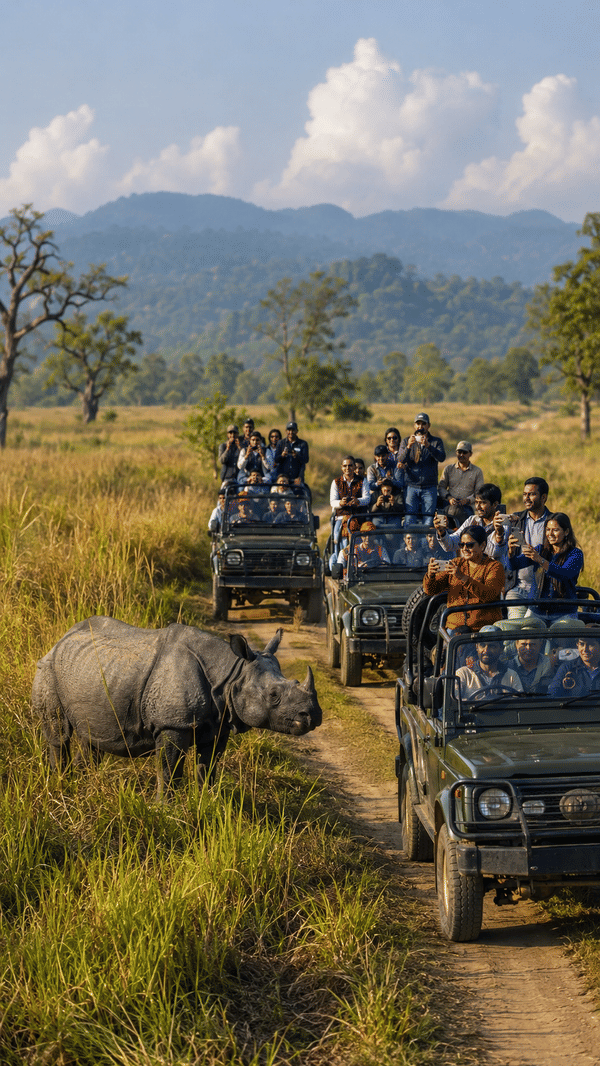
Thanks to the WanderOn team for crafting a beautiful itinerary to Meghalaya. Our group was led by Saheb Raja, who shared amazing local stories which kept each one of us hooked wanting for more The best part indeed has to be the safari where we got to spot 7 rhinos in the western range of Kaziranga, visit to few of the best waterfalls, the trek to living root bridges (it was quite challenging, but the team spirit and fun along the way made it relatively easier) and needless to say the living root bridge in itself.
P.s: At the time of booking, I was misinformed about the stays and the number of people traveling from my city. Hence the 4.5 stars. However, WanderOn staying true to its claim, managed to provide best accommodations with food for the price range and amazing stopovers to explore local cuisine.
Frequently Asked Questions
Your right to Know!
01
Is Meghalaya Safe For Solo Travelers And Women Travelers?
Meghalaya is generally regarded as one of the safer states in Northeast India for solo travel, including for women. Khasi society is matrilineal, and women have a strong social position in many communities. You still need to follow usual precautions, especially in remote areas after dark. Pick verified homestays, share your plans with someone you trust, and listen to your instincts.
02
Do I Need Any Special Permits To Visit Meghalaya?
Most Indian nationals and foreign tourists do not need to get special permits for mainstream destinations like Shillong, Cherrapunji, Dawki and Mawlynnong. A Protected Area Permit (PAP) applies only to certain restricted border zones. Foreign nationals do need a valid Indian Tourist Visa. Check the latest rules on the official Meghalaya Tourism portal before you travel.
03
What Is The Best Way To Get Around Within Meghalaya?
If you're covering multiple districts, a private cab for the duration is usually the most practical and flexible option. Shared taxis connect major towns, but they run on fixed routes and informal schedules. For Nongriat and other village walks, you'll be on foot. Renting a scooter or motorcycle in Shillong is also possible and is popular for day trips. A Meghalaya trip from Guwahati is most convenient by cab.
04
How Physically Demanding Is The Nongriat Trek To The Living Root Bridges?
Expect a steep stair trek: roughly 3,500 stone steps and about 3.5 km each way. Many moderately fit travelers take 45 to 90 minutes to descend and 90 to 120 minutes to climb back up. It's not technical, but the steps can be slippery when wet. Wear shoes with good grip, carry water, and consider an overnight stay in Nongriat to spread the effort across two days.
05
What Should I Pack For A Meghalaya Trip?
The weather in Meghalaya can be unpredictable so pack in layers. Pack light, quick-drying clothes, a waterproof jacket and fleece for the cooler evenings. Also carry waterproof trekking shoes with good grip, sunscreen, insect-repellent, a reusable water bottle, a power bank and any personal medications.
Meghalaya Travel Guidelines
1. Pack for rain year-round, as Meghalaya is one of the wettest regions on earth and sudden downpours can happen any month.
2. Wear sturdy non-slip footwear for the steep stone-step hikes to living root bridges around Cherrapunji and Nongriat.
3. Cave exploration needs a local guide, proper gear, and awareness of flash-flood risks in Meghalaya's limestone cave systems.
4. Mobile connectivity thins out in Meghalaya's interior — download offline maps before heading to Dawki, Mawlynnong, or Laitlum.
5. Carry cash for remote Meghalaya homestays and markets, where UPI and card payments are often unreliable or unavailable.
6. Respect Khasi and Garo tribal customs — ask before photographing people, festivals, or sacred groves like Mawphlang.